Why 5G's Spectral Efficiency Beats 4G: A Technical Deep Dive

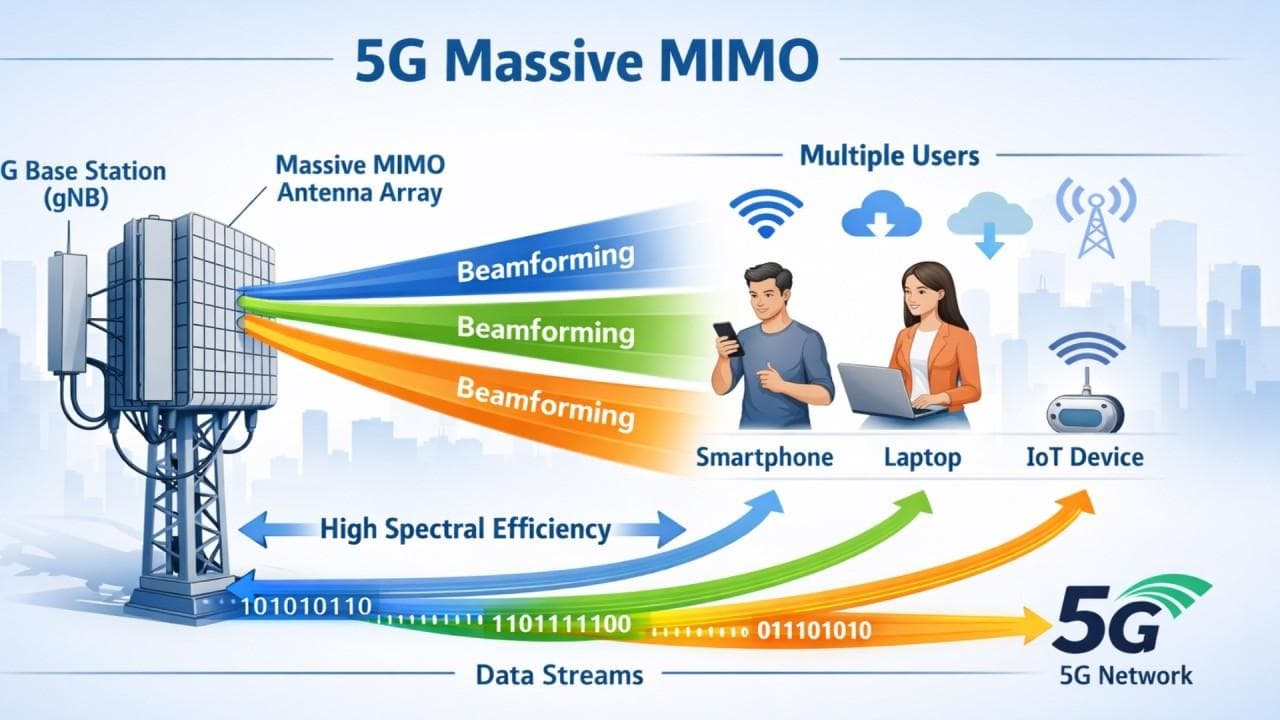
If you've ever wondered why 5G feels so much faster than 4G even in places where the bandwidth (MHz of spectrum) looks similar, the answer isn't just “more spectrum”. It's spectral efficiency, how many bits of data a network can squeeze through every hertz of radio spectrum it's given. This post breaks down what that means, why 5G is dramatically better at it, and shows the numbers behind the claim.
1. What Is "Spectral Efficiency"?
Spectral efficiency is measured in bits per second per Hertz (bit/s/Hz). It answers the question: For every 1 Hz of radio spectrum you own, how many bits per second can you actually push through it. Think of spectrum like a highway and spectral efficiency like the number of cars that can safely fit per lane, per minute. Two networks can have the exact same highway (same amount of spectrum, say 100 MHz), but the one with smarter traffic management (better spectral efficiency) moves far more data. This matters because spectrum is scarce and expensive, governments auction it for billions of dollars. A network that extracts more throughput from the same slice of spectrum delivers more capacity without needing new frequency bands.
The formula in its simplest form:
Throughput (bits/sec) = Spectral Efficiency (bit/s/Hz) × Bandwidth (Hz)
So, if 5G roughly doubles spectral efficiency compared to 4G, it doubles your speed even on identical bandwidth and that's before 5G's additional spectrum (like mmWave) is even considered.
2. The Headline Numbers: 4G vs 5G
The International Telecommunication Union (ITU) sets official minimum requirements for each generation: IMT-Advanced for 4G and IMT-2020 for 5G. Here's how they compare:
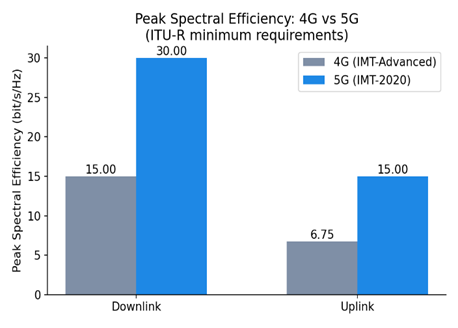
5G's downlink peak spectral efficiency requirement is 30-bit/s/Hz, exactly double the 15-bit/s/Hz required of 4G. On the uplink, it's also double: 15 vs 6.75-bit/s/Hz.
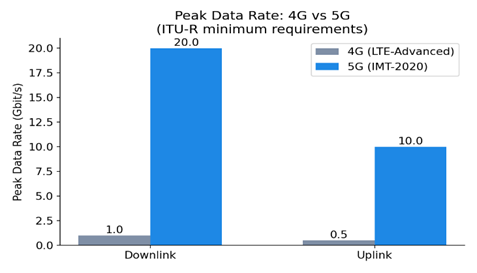
That efficiency gain, combined with wider channels, translates into a huge jump in real peak data rates:
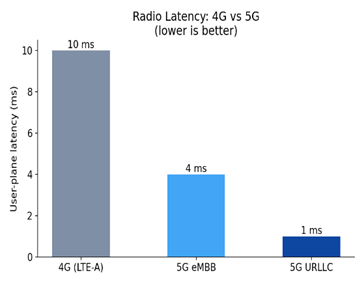
And because 5G's air interface was designed from scratch for low delay, latency drops sharply too; critical for gaming, remote surgery, or self-driving cars:
Example: A stadium with 100 MHz of spectrum available to a carrier:
Ø Under 4G limits of 20 MHz bandwidth (~5–6-bit/s/Hz achievable in real deployments): roughly 100–120 Mbps of usable downlink capacity to share among everyone in that cell.
Ø Under 5G with Massive MIMO (~10–12-bit/s/Hz achievable in real deployments): roughly 1 – 1.2 Gbps of usable downlink capacity, almost ten times more people can stream HD video at once, in the same spectrum.
3. Why Is 5G So Much More Efficient? The Technical Building Blocks
Spectral efficiency isn't one trick, it's the sum of several design changes in 5G's radio system (5G NR, or New Radio). Here are the key ones, explained in plain language.
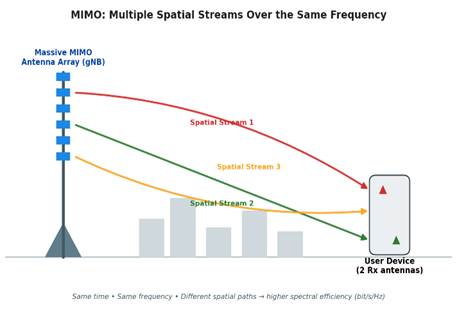
3.1 Massive MIMO (Multiple-Input, Multiple-Output)
Ø What it is: MIMO uses multiple antennas at both the transmitter (cell tower) and receiver (phone) to send several independent data streams over the same frequency at the same time.
Ø 4G vs 5G: 4G typically uses 2x2 or 4x4 MIMO (2 or 4 antennas). 5G base stations use Massive MIMO, with 64, 128 or even more antenna elements.
Ø Why it boosts efficiency: more antennas mean more simultaneous, non-interfering spatial “lanes” of data through the same chunk of spectrum, directly multiplying bit/s/Hz.
3.2 Beamforming
Ø What it is: Instead of broadcasting a signal in all directions (like a lightbulb), beamforming uses the antenna array to focus radio energy into a narrow, directed beam aimed straight at a specific device (like a flashlight).
Ø Why it boosts efficiency: a focused beam suffers less interference and reaches the device with a stronger, cleaner signal, enabling higher-order modulation and fewer retransmissions, which raises effective throughput per Hz. It also lets a base station serve many users at once with beams pointed in different directions, reusing the same spectrum simultaneously (“spatial multiplexing”).
3.3 Higher-Order Modulation (256-QAM and beyond)
Ø What it is: QAM (Quadrature Amplitude Modulation) is the scheme used to encode bits onto a radio wave, by varying its amplitude and phase. The number (e.g., 64-QAM, 256-QAM) is how many distinct symbol states are packed onto each wave — more states mean more bits per symbol.
Ø 4G vs 5G: 4G commonly uses 64-QAM (6 bits/symbol) and optionally 256-QAM in good conditions. 5G supports 256-QAM as standard on the downlink and pushes higher-order schemes more aggressively thanks to cleaner beamformed signals. 3GPP NR also introduced 1024-QAM for downlink in Release 17 for suitable high-SINR scenarios.
Ø Why it boosts efficiency: more bits per symbol directly means more bits per second for the same amount of spectrum, provided the signal quality (SNR) is good enough to distinguish the finer-grained symbol states. This is only practical because beamforming (3.2) keeps the signal clean.
3.4 Flexible Numerology and Wider Channels
Ø What it is: “Numerology” refers to the subcarrier spacing in the OFDM waveform (explained next). 4G LTE is locked to a fixed 15 kHz subcarrier spacing. 5G NR supports multiple spacings (15, 30, 60, 120 kHz...) chosen based on the frequency band and use case.
Ø Why it boosts efficiency: wider subcarrier spacing at high frequencies (like mmWave) reduces sensitivity to phase noise and Doppler shift, allowing very wide channels (up to 400 MHz per carrier) to be used efficiently, something 4G's rigid design can't do.
3.5 OFDM / OFDMA (Orthogonal Frequency-Division Multiple Access)
Ø What it is: Both 4G and 5G split a wide channel into many narrow, mathematically “orthogonal” (non-interfering) subcarriers, each carrying part of the data. OFDMA lets the network dynamically allocate small groups of these subcarriers to different users simultaneously.
Ø 5G's refinement: 5G's flexible numerology (above) and more granular resource allocation (“mini-slots”) let the scheduler pack subcarriers more precisely to each user's channel conditions and latency needs, squeezing out more usable capacity than 4G's more rigid scheduling grid.
3.6 Advanced Channel Coding: LDPC and Polar Codes
Ø What it is: Channel coding adds controlled redundancy to data so errors from noise/interference can be detected and corrected without retransmission. 4G LTE uses “Turbo codes”. 5G NR switched to LDPC (Low-Density Parity-Check) codes for data channels and “Polar codes” for control channels.
Ø Why it boosts efficiency: LDPC and Polar codes get closer to the theoretical maximum (the Shannon limit) of how much data can be reliably sent for a given noise level and they decode faster in parallel hardware, meaning less overhead is wasted on redundancy and higher data rates can be sustained at a given signal quality.
3.7 Carrier Aggregation(CA) & Dual Connectivity (DC)
Ø What it is: Combining multiple frequency bands/carriers (CA: Combines multiple frequency channels from a single base station to create a wider virtual data pipe and DC: Allows a device to connect to two different base stations even across 4G and 5G, called “Non-Standalone or NSA mode” also known as EN-DC so a device transmits/receives across several channels at once.
Ø Why it boosts efficiency: while this mainly adds raw bandwidth rather than bit/s/Hz itself, 5G's scheduler manages aggregation more efficiently across widely different band types (low, mid, mmWave), extracting more usable throughput from the combined pool.
3.8 Millimeter Wave (mmWave) and Mid-Band Spectrum
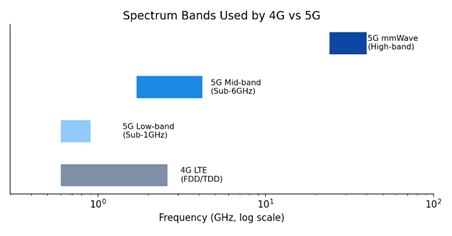
Spectrum bands 4G vs 5G
Ø 4G mostly operates below 3 GHz.
Ø 5G adds mid-band (sub-6 GHz, roughly 1–6 GHz) for a balance of coverage and capacity and mmWave (24–40+ GHz) for extremely wide channels (hundreds of MHz) in dense urban hotspots.
Ø mmWave doesn't inherently have higher bit/s/Hz efficiency, its huge advantage is sheer bandwidth availability but combined with beamforming (which is essential at these frequencies to overcome high path loss), it delivers enormous total throughput.
3.9 Network Slicing and Edge Computing (System-Level Design)
Beyond the radio link itself, 5G's core network (5GC) is built differently:
Ø Network Slicing: the operator can carve one physical network into multiple virtual, isolated “slices”, for example, one slice tuned for massive IoT sensors (low throughput, huge device count), another for enhanced mobile broadband, another for ultra-reliable low-latency use (like factory robotics). Each slice gets resources matched to its needs instead of one-size-fits-all provisioning, which indirectly improves how efficiently the shared infrastructure and spectrum are used.
Ø Multi-access Edge Computing (MEC): processing moves physically closer to the user (e.g., at the cell site) rather than a distant data center, cutting round-trip latency, complementary to the radio-level latency gains in Section 2.
Ø Service-Based Architecture (SBA): the 5G core is built from modular, virtualized network functions communicating over standard APIs, making it easier to scale capacity dynamically where and when it's needed.
4.The Easiest Way to Understand Difference
The easiest way to understand the evolution is:
4G LTE
Spectrum + OFDM + MIMO + Adaptive Modulation/Coding
5G NR
Spectrum + OFDM + Massive MIMO + Beamforming + Spatial Multiplexing + Advanced Coding + Flexible Numerology + Intelligent Scheduling + Interference Management
5G therefore does not rely on a single revolutionary technology. Its efficiency comes from several improvements working together.
5. Quick Glossary
Term | Meaning |
Spectral Efficiency | Data throughput per Hz of spectrum (bit/s/Hz) |
MIMO | Multiple antennas sending/receiving multiple data streams simultaneously |
Massive MIMO | MIMO scaled up to dozens/hundreds of antenna elements (5G) |
Beamforming | Focusing radio signal energy directionally toward a specific device |
QAM | Modulation scheme; higher order (e.g., 256-QAM) = more bits per radio symbol |
OFDM/OFDMA | Splitting a channel into many small subcarriers, allocated flexibly among users |
Numerology | The subcarrier spacing configuration in 5G NR's OFDM waveform |
LDPC / Polar Codes | Advanced error-correction coding used in 5G (vs Turbo codes in 4G) |
mmWave | Very high frequency bands (24–40+ GHz) offering huge bandwidth, short range |
Network Slicing | Dividing one physical 5G network into isolated virtual networks per use case |
gNB | The 5G equivalent of a cell tower/base station (vs "eNB" in 4G) |
5GC | The 5G Core network — the virtualized backend routing and managing 5G traffic |
EN-DC | E-UTRA-NR Dual Connectivity |
6. Conclusion
5G isn't faster than 4G just because operators bought more spectrum, it's faster because every hertz of that spectrum does more work. Massive MIMO and beamforming create more simultaneous spatial data streams; higher-order modulation and better channel coding pack more bits into each of those streams; and flexible numerology plus a redesigned core let the network use it all more intelligently. Together, these design choices roughly double the spectral efficiency ceiling set by international standards and in real-world dense deployments, the practical gains can be even larger once you add 5G's extra spectrum in mid-band and mmWave.
That's the real story behind "5G is faster than 4G": not only a bigger highway, but far smarter traffic control on every lane also.
*Sources for reference figures: ITU-R Report M.2410 (IMT-2020 requirements) and ITU-R Report M.2134 (IMT-Advanced requirements).
Disclaimer
The views and technical opinions expressed in this blog are my own and are presented from my perspective as a Communication Engineer. They are intended for technical discussion and knowledge sharing and should not be considered an official position, policy or statement of any organization or institution with which I am affiliated.