Choosing Nepal’s 5G Spectrum: Balancing Coverage, Capacity, Cost and Device Compatibility

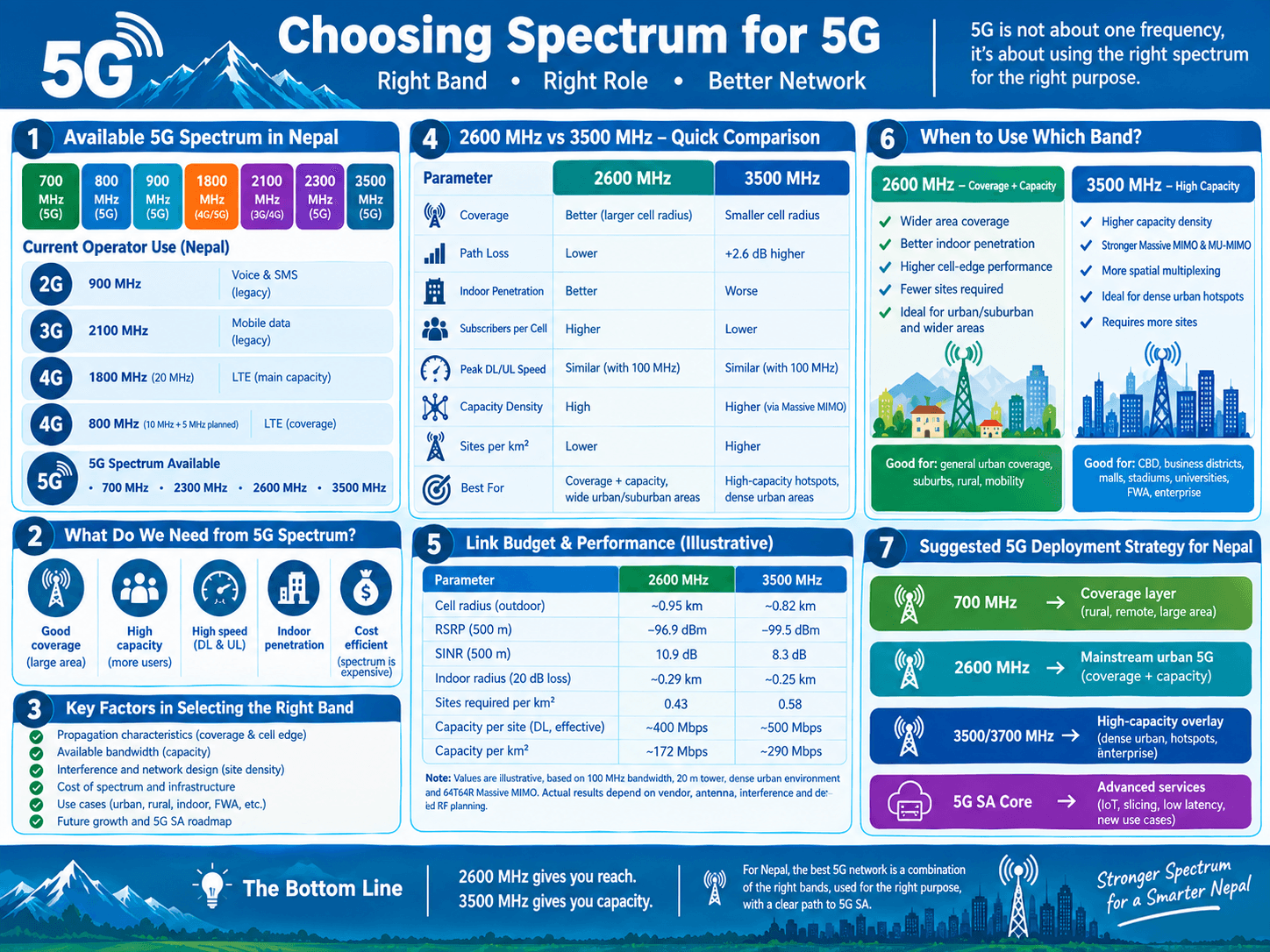
Nepali operators face a genuinely complex strategic decision when selecting spectrum for 5G deployment. Spectrum represents one of the most significant capital investments in a 5G rollout and choosing the wrong band can lead to substantial additional costs, first for a spectrum license that may not align well with the initial NSA deployment and later when transitioning to Standalone (SA) requires a different spectrum strategy. This article examines how the four bands under consideration, 700 MHz, 2300 MHz, 2600 MHz, and 3500 MHz, compare in terms of coverage, capacity, and deployment requirements, and explains why the sequencing of these bands can be just as important as the choice of the bands themselves.

Grey blocks: bands already carrying 2G/3G/4G traffic today. Coloured blocks: the four bands proposed for 5G. Position along the line is roughly to scale; height only distinguishes the bands.
The Four Candidates: A Technical Profile
700 MHz (3GPP band n28) is a sub-1 GHz low-band. Its physics are its whole value proposition: excellent building penetration and long-range macro coverage, which matters enormously in Nepal's terrain, hill shadowing, scattered rural settlements and the sheer cost of tower density in mountainous districts. The tradeoff is capacity: n28 gives coverage to indoor and low-density areas but its top speed is close to 4G because it carries roughly the same amount of spectrum as 4G already uses at 800 MHz, so it's a coverage and reach layer, not a capacity layer.
2300 MHz (band n40, TDD) is technically defined for 5G NR, but in practice it has lived mostly as a 4G TD-LTE band (this is the "BWA"-style band used in several South Asian deployments). It doesn't carry the same weight in the global 5G device ecosystem as the other three: chipset and RF front-end support for n40 lags well behind n78, n41 and n28. That's a real constraint, not a paper one: a band with no phones behind it doesn't generate revenue no matter how good the auction price looks.
2600 MHz (bands n7/n38/n41 depending on duplex and pairing) sits in true mid-band territory and is exactly what Nepal already tested, achieving 1 Gbps peak throughput using 60 MHz in this band. It offers a solid coverage-to-capacity balance, sits below 3.5 GHz in propagation loss, and critically for Nepal, already has a domestic performance benchmark from real trials rather than vendor slideware.
3500 MHz (band n78) is the global 5G "workhorse" band. It's the primary band for 5G, capable of up to 1 Gbps under good conditions and it's the band around which the overwhelming majority of the world's 5G radio and device ecosystem has been built. Propagation is shorter-range and less penetrating than sub-1 GHz bands: 700 MHz reaches well into buildings while 3.5 GHz struggles even with a thin wall and the effective cell radius at 3.5 GHz is much smaller but this is the band where massive MIMO, wide contiguous carriers and the deepest vendor/device support all converge.
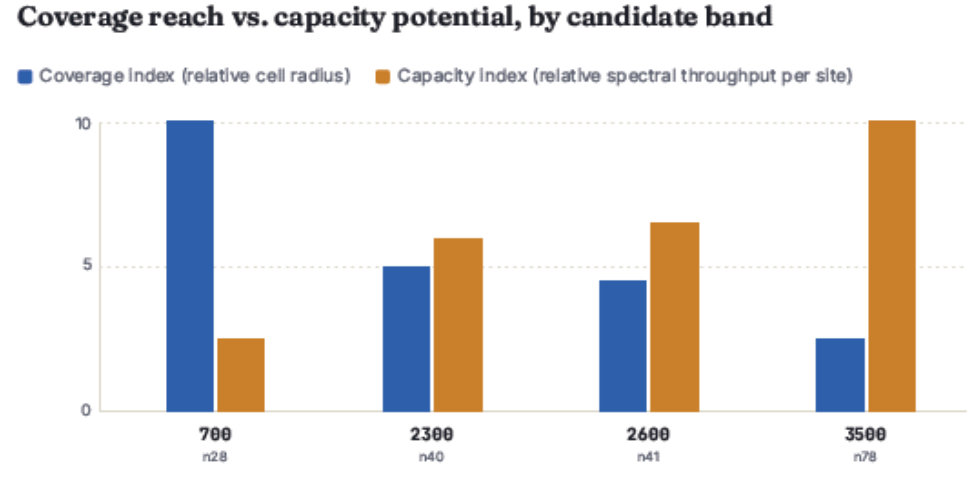
Index values (0–10) are illustrative, not measured Nepal data — they compress standard macro link-budget behavior (path loss, penetration, diffraction, available channel bandwidth) into a single comparable scale. The crossover is the point: 700 MHz gives up almost all its capacity advantage to reach hill villages; 3500 MHz gives up almost all its reach to deliver dense-urban speed.
The Handset Reality Check
This is the part operators often underweight and it's decisive for revenue timing. As of the most recent industry tracking:
- GSA has catalogued over 4,000 announced 5G devices of which more than 90% are commercially available spanning 330+ manufacturers.
- 81.7% of devices support sub-6 GHz spectrum and band n78 remains the most widely supported band followed by n41, n1 and n77.
- n28 (700 MHz) rides on the back of strong global low-band adoption (it doubles as a widely-supported LTE band too), so device support is broad even though it's not the single most-supported 5G band.
- n40 (2300 MHz) is conspicuously absent from that top tier, it's a second-order band in terms of chipset penetration for 5G specifically.
In plain terms: if you launch on 3500 MHz, essentially every 5G phone entering the Nepali market today can use it. If you launch primarily on 2300 MHz, you are betting on a narrower and less certain device population.
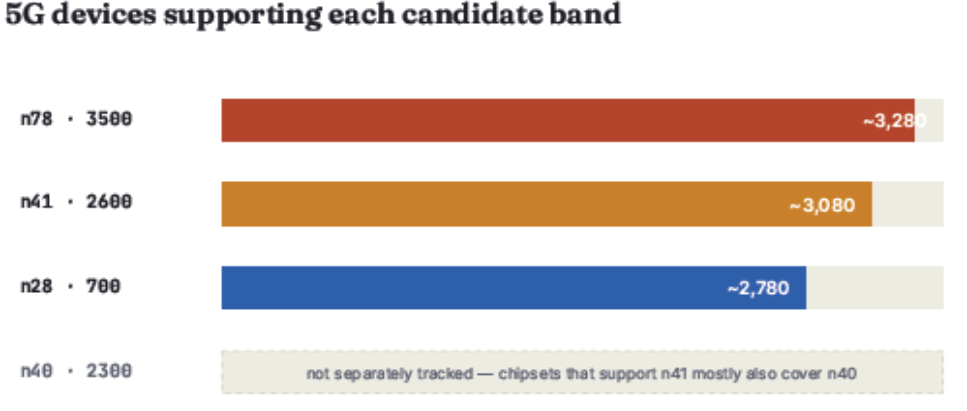
Figures are an indicative snapshot of relative band-support ranking from GSA's device database, not a live count, treat the ordering (n78 > n41 > n28) as the reliable signal.
Why This Matters More for NSA Than People Expect
NSA (Non-Standalone) 5G uses a 4G "anchor" carrier for control-plane signaling and mobility with the 5G NR carrier bolted on for data, it needs no new core. Nepal's operators already have two usable anchors (1800, 800 MHz LTE), so the anchor question is basically solved. What's not solved is which band should carry the actual 5G data layer, since that's what determines whether users perceive any speed benefit at all.
This is where the "spectrum is expensive" constraint bites hardest: a single wide block of contiguous mid/high-band spectrum (ideally 3500 MHz) delivers far more perceptible benefit per MHz than the same money spent thinly across several bands. NSA is precisely the phase where you want your capital concentrated in one band with maximum device compatibility, because that's what converts spectrum spend into subscriber-visible throughput fastest.
A Phased Recommendation
Phase 1: NSA launch:
Anchor on existing LTE (1800/800) and deploy the 5G NR carrier primarily on 3500 MHz. It has the deepest global device support, the largest realistic contiguous bandwidth and it's the band the rest of the industry; chipsets, RAN vendors, roadmap R&D; is optimizing for. Concentrate initial rollout in Kathmandu Valley and other urban centers where 3500 MHz's shorter range is less of a liability and user density justifies the capacity gain.
Fallback/capacity option - 2600 MHz is the pragmatic hedge. It already has a proven local performance record from Nepal's own trials, sits in a friendlier propagation zone than 3500 MHz, and can be prioritized if the 3500 MHz auction price or block size turns out to be uneconomical.
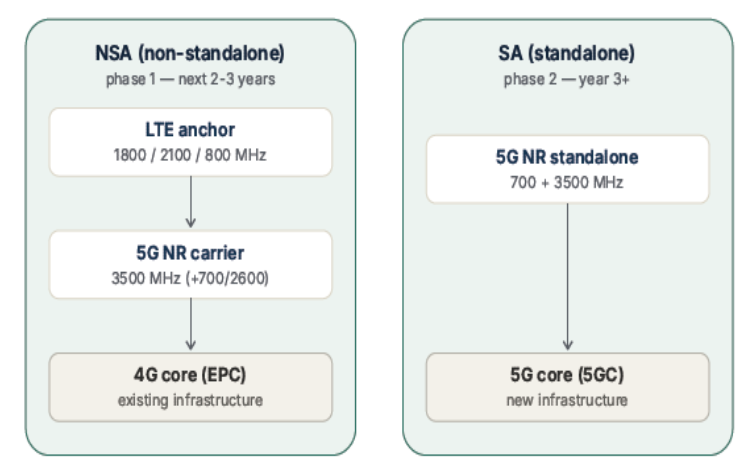
NSA reuses existing LTE anchors and the 4G core for a fast, low-capex launch. SA later swaps in a new core and 700 MHz stops being a fallback and becomes a genuine coverage layer alongside 3500 MHz.
2600 MHz vs 3500 MHz : Dense Urban, 20 m Tower, 100 MHz BW
Why they behave differently: the physics first
Both are mid-band, both likely deployed as TDD at 100 MHz (n38/n41 for 2600 MHz, n78 for 3500 MHz), so raw channel bandwidth is identical. The difference comes entirely from frequency-dependent propagation:
- Free space path loss (FSPL): FSPL = 20log₁₀(d) + 20log₁₀(f) + 32.44
Extra loss of 3500 MHz over 2600 MHz at the same distance:
20 × log₁₀(3500/2600) ≈ 2.6 dB more loss, purely from frequency.
- Building penetration loss (dense construction: concrete, rebar, low-E glass): higher frequency penetrates worse. Typical measured gap between 2.6 GHz and 3.5 GHz in dense urban buildings is another 3 to 6 dB.
- Combined disadvantage for 3500 MHz: roughly 5 to 9 dB more total loss than 2600 MHz at the same point, in this exact scenario.
Phase 2: SA migration:
The core network shift to SA doesn't actually change which radio bands are useful, it changes what they can do. Under SA, low-band spectrum (700 MHz) becomes far more valuable than it is under NSA, because SA enables full network slicing, ultra-low latency and massive IoT use cases that specifically benefit from wide-area low-band coverage combined with mid-band capacity. The classic global pattern, and the one Nepal should aim for, is a dual-layer architecture: 700 MHz for reach, 3500 MHz for capacity, with 2600 MHz filling in as a secondary capacity band if additional bandwidth is needed once demand grows.
5G Band Selection for Nepal: NSA First, SA Later
Phase | Layer | Band | Role |
|---|---|---|---|
NSA (Option 3x) | LTE anchor (existing) | 1800 MHz (20 MHz), 800 MHz (10 to 15 MHz) | Control plane, coverage, uplink |
5G NR capacity layer | 3500 MHz (n78), 80 to 100 MHz TDD | Main 5G data layer | |
SA (later) | Coverage layer | 700 MHz (n28), FDD | Nationwide and indoor coverage, uplink, IoT |
Capacity layer | 3500 MHz (+ 2600 MHz if needed) | eMBB, carrier aggregation |
Why 3500 MHz for NSA
- Bandwidth is what 5G speed depends on. 3500 MHz is the only listed band where a contiguous 80 to 100 MHz carrier is realistic. 700 MHz gives roughly 2x10 MHz at best, and 2300/2600 MHz usually give 20 to 60 MHz. Without wide carriers, 5G barely beats a well-tuned 4G with 20 MHz at 1800 MHz.
- Massive MIMO is practical here. At 3.5 GHz, 32T32R or 64T64R antennas are a manageable size and weight, giving beamforming gain and higher spectral efficiency (roughly 3 to 5 times LTE per site). That recovers the cost of the expensive spectrum.
- It has the best ecosystem. n78 is the most widely supported 5G band in devices and network equipment, which means cheaper handsets, faster adoption and lower equipment costs.
- The coverage-capacity balance is good enough for NSA. 3.5 GHz has weaker coverage than 1800 MHz, but in NSA the LTE anchor provides control-plane coverage and the NR carrier boosts data in urban and dense areas. Nepal's dense cities (Kathmandu Valley, Pokhara, Biratnagar, Birgunj) can be covered with existing 1800 MHz site grids, with some infill.
- NSA hides the weak 3.5 GHz uplink. TDD at 3.5 GHz has a poor uplink budget. In EN-DC, uplink can be carried on LTE 1800/800 MHz, so users keep good uplink performance.
- The existing LTE spectrum is protected. 1800 MHz and 800 MHz stay as anchors and are not re-farmed early, so there is no disruption to current 4G customers.
Why not the other bands first
- 700 MHz: Excellent coverage and indoor penetration, but very little bandwidth, so it gives only small capacity gains. It is a poor first buy for speed, and it is expensive per MHz because of its coverage value. It is better acquired for SA, when standalone coverage matters.
- 2600 MHz (n41/n38): A good fallback if 3500 MHz is too expensive or unavailable. It has decent bandwidth (up to about 60 to 100 MHz) and a mature device ecosystem, but weaker Massive MIMO economics than 3.5 GHz and less global 5G scale.
- 2300 MHz (n40): Narrow bandwidth (typically 30 to 50 MHz), limited global 5G ecosystem, and fewer 5G handsets support it. It is best used for capacity densification or carrier aggregation later.
Cost strategy: Since spectrum is costly, buy a right-sized block of 3500 MHz first (about 60 to 80 MHz minimum, 100 MHz ideal) rather than several bands at once. Reuse existing sites, towers and LTE spectrum, and defer 700 MHz until SA justifies it.
Why 700 MHz (plus 3500 MHz) for SA
- SA needs its own coverage. With no LTE anchor, the NR network must provide control-plane and mobility coverage by itself. 700 MHz gives about 3 to 4 times the coverage area of 3.5 GHz, which suits Nepal's hilly terrain and scattered rural settlements.
- It fixes uplink. FDD 700 MHz has a strong uplink, whereas 3.5 GHz uplink is weak in SA without an LTE anchor.
- Indoor and deep-indoor penetration is much better, supporting VoNR and reliable indoor 5G.
- It enables IoT and mMTC, such as smart metering, agriculture and hydropower monitoring, using wide-area, low-power coverage.
- A layered SA design works best: 700 MHz for coverage, 3500 MHz for capacity, with carrier aggregation (or 2600/2300 MHz) to add more capacity where traffic grows.
When to start SA
SA should follow NSA by roughly 2 to 3 years for Nepal. The decision should depend on these triggers:
1. 5G device penetration reaches about 25 to 30% of subscribers, with SA-capable handsets common.
2. 5G Core (5GC) is deployed, tested and interoperable with stable vendor support and VoNR is ready to replace VoLTE.
3. LTE anchor capacity is stressed. Growing 5G traffic loads the anchor's signaling and 1800 MHz resources which is when NSA becomes inefficient.
4. Demand for SA-only features appears: network slicing, low latency (URLLC), fixed wireless access at scale, private enterprise networks and industrial or smart-city use cases.
5. 700 MHz spectrum is acquired and can be deployed (for example, cleared of broadcasting use where relevant).
6. The business case is positive. NSA has generated revenue that can fund core and spectrum investment and regulatory policies (spectrum pricing, licensing, tower sharing) are supportive.
Takeaway:
Start with NSA on 3500 MHz (anchored on the existing 1800/800 MHz LTE) because it gives the best speed, ecosystem and return on expensive spectrum. Move to SA by adding 700 MHz for coverage and uplink while using 3500 MHz for capacity, once devices, the 5G core and demand are ready.
Conclusion:
Nepal doesn't have to choose between a 5G network that reaches people and one that impresses them with speed, but it does have to sequence the two correctly. Coverage economics in a landlocked, mountainous, lower-middle-income country push hard toward low-band spectrum as the backbone; capacity economics in Kathmandu, Pokhara and the Terai' s fast-growing municipalities push equally hard toward mid- or/and high-band spectrum layered on top. The device ecosystem data confirms that subscribers can afford to follow wherever the network goes on 2600 MHz or/and 3500 MHz, and will be able to afford 700 MHz devices without much delay either. The technical work left is not choosing a band - it' s finishing the interference clearing, agreeing the TDD synchronization rules and deciding how wide each operator' s mid-band channel will be. Get that layering and sequencing right and Nepal' s 5G rollout can be both nationally inclusive and genuinely fast where it counts.
Disclaimer
The views and technical opinions expressed in this blog are my own and are presented from my perspective as a Communication Engineer. They are intended for technical discussion and knowledge sharing and should not be considered an official position, policy or statement of any organization or institution with which I am affiliated.