AI-RAN Explained: How AI Is Making Mobile Networks Smarter

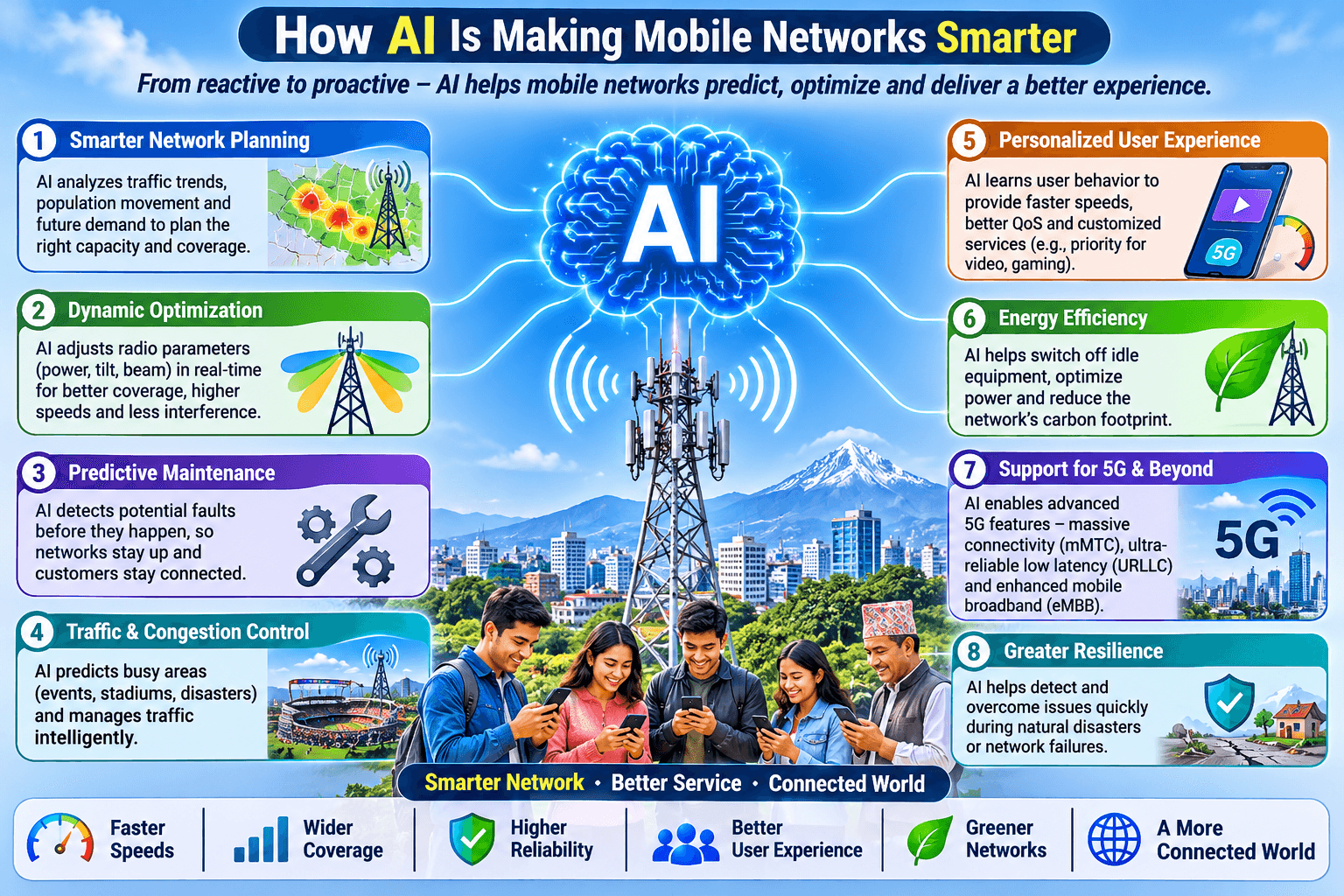
Realization: when your network is under strain
Picture a busy commercial street in any metro city just after office hours. Thousands of people pull out their phones at once: video calls, maps, messaging, streaming. One LTE cell is suddenly at 88% resource utilization, and download speeds start to fall. Next door, a neighboring cell sits at 52%, with plenty of spare capacity.
A traditional network reacts after users complain or KPIs drop. An AI-assisted network can spot the pattern 30 minutes earlier, recommend moving some traffic to the neighboring cell, and then confirm the fix worked.
That is the promise of AI-RAN: artificial intelligence for the Radio Access Network. This article walks through how it works, where it helps, where it does not, and what a realistic path looks like for Nepal's mobile operators.
Key takeaways
- AI-RAN adds prediction to network operations. It forecasts congestion, faults, and energy-saving opportunities instead of only reacting to them.
- It has three pillars: AI for RAN (improves the network), AI and RAN (shares computing hardware), AI on RAN (runs AI services at the network edge). The first is the most mature.
- It does not replace radio engineering. Standards, protocols, and engineering safeguards stay; AI helps engineers decide better and earlier.
- Start small. Monitor, predict, recommend, then automate with guardrails. Nepal can begin on existing LTE without waiting for 5G.
1. The RAN at a Glance
The Radio Access Network (RAN) is the part of a mobile network that connects devices (smartphones, tablets, IoT) to the operator's core network over radio links. It includes antennas, radio equipment, baseband processing, and control functions.
- In 4G LTE the base station is called an eNodeB (eNB).
- In 5G NR it is a gNodeB (gNB), which may be one unit or split into a Central Unit (CU), Distributed Unit (DU), and Radio Unit (RU).
The RAN schedules radio resources, chooses modulation and coding, adapts the link, reports measurements, and supports mobility. Many of these tasks run under very strict timing limits, so where and how fast an AI model executes is a real architectural decision.
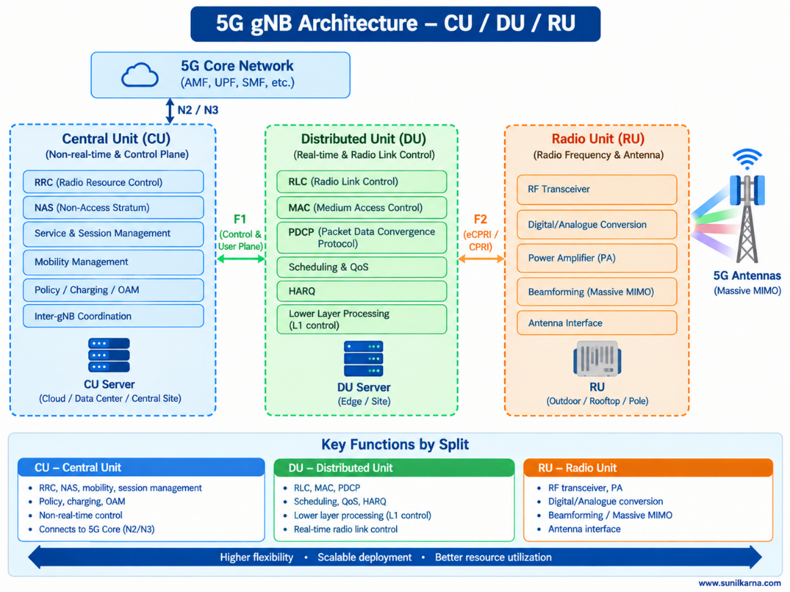
Figure 1: Simplified end-to-end mobile network architecture.
2. Why mobile networks need AI now
Three forces are pushing the industry toward AI-RAN at the same time.
The RAN is expensive and power-hungry
Industry estimates commonly put the RAN at roughly 60 to 80 percent of an operator's network energy use, and it dominates capital spending because every site needs radios, antennas, power, backhaul, and maintenance. Even single-digit efficiency gains are valuable at scale.
It has become too complex to tune by hand
A modern site may combine several frequency bands, Massive MIMO with 32 or 64 transceiver chains, carrier aggregation, dual connectivity, network slicing, and a mix of macro, small-cell, and indoor layers. This growing interaction of parameters has outgrown traditional rule-based Self-Organizing Network (SON) functions.
The hardware is becoming programmable
Virtualized and Open RAN moved baseband processing onto general-purpose servers, and GPU-accelerated platforms can now handle demanding signal processing, even Layer 1, alongside AI workloads. When the RAN is software-defined, AI can move from watching the network to being part of radio processing and real-time decisions.
This convergence is what the industry calls AI-RAN. The AI-RAN Alliance launched at Mobile World Congress in February 2024 with operators, vendors, chipmakers, cloud providers, and universities, aiming to speed up AI integration and make the RAN a platform for AI services.
The day-to-day pain points
Traditional optimization follows a loop: monitor KPIs, spot degradation, find the root cause, adjust parameters, check the result. It still works, but the workload explodes as networks grow. Five challenges stand out:
Challenge | What makes it hard |
|---|---|
Radio complexity | Carrier aggregation, Massive MIMO, beamforming, and multi-band layouts create many interacting parameters |
Shifting traffic | A cell quiet in the morning may be congested in the evening |
Energy efficiency | Power must drop without hurting coverage, capacity, or availability |
Mobility and interference | User movement and neighboring-cell interactions complicate tuning |
Operational scale | Huge volumes of counters, alarms, measurements, and configs to analyze |
A reality check: AI does not fix everything. Poor coverage may need a new site, RF power enhancement, sector expansion, or antenna alignment reversal; limited spectrum needs more bandwidth, and backhaul congestion needs transport upgrades. The value of AI is helping operators make better-informed decisions, more consistently and earlier.
3. What exactly is AI-RAN?
AI-RAN integrates AI and machine learning into and around RAN infrastructure to improve performance, automate operations, and use computing resources more efficiently. It does not mean replacing every conventional radio algorithm; standardized procedures and operational safeguards remain essential.
The AI-RAN Alliance describes three complementary pillars.
Pillar 1: AI for RAN (AI that improves the network)
ML models enhance RAN functions such as scheduling, beamforming, channel estimation, mobility management, energy saving, interference coordination, and fault prediction. Goals: better spectral efficiency, lower energy per bit, higher reliability, less manual tuning. This is the most mature pillar, with the clearest standards path.
Example: predict congestion in an LTE cell and recommend traffic steering before throughput drops.
Pillar 2: AI and RAN (shared infrastructure)
RAN processing and AI workloads run on the same accelerated computing platform. A rural base station at 3 a.m. has very little traffic, so dedicated baseband hardware sits idle. On a shared, software-defined platform, spare capacity can serve video analytics, local LLMs, or enterprise applications. The benefit is better utilization of hardware operators already need to deploy, wherever timing, resource isolation, and economics allow.
Example: an edge platform hosts virtualized RAN functions plus a separate AI inference workload.
Pillar 3: AI on RAN (AI services delivered over the RAN)
The RAN provides both connectivity and nearby computing for AI applications: camera-based quality inspection in a factory, an AR assistant, connected vehicles, or a smartphone AI assistant. The RAN site becomes a local AI hub with lower delay and data kept close to where it is generated.
Example: an industrial application processes video at an edge site instead of sending raw footage to a distant cloud.
The three pillars at a glance
Pillar | AI's role | Typical examples | Maturity |
|---|---|---|---|
AI-for-RAN | Makes the RAN better | Neural receivers, CSI compression, energy saving | Most mature; in standards and field trials |
AI-and-RAN | Shares compute with the RAN | RAN + inference on one GPU platform | Early commercial pilots and trials |
AI-on-RAN | Runs applications at the RAN edge | Video analytics, private-network AI | Emerging |
This article focuses on AI-for-RAN, where most of the radio engineering lives, and covers the shared-compute architecture that enables the other two.
4. How AI-RAN works: from data to decisions
AI-RAN turns network measurements into predictions and, where appropriate, controlled actions. Think of it as a five-stage loop: collect, prepare, learn, decide and act, verify.
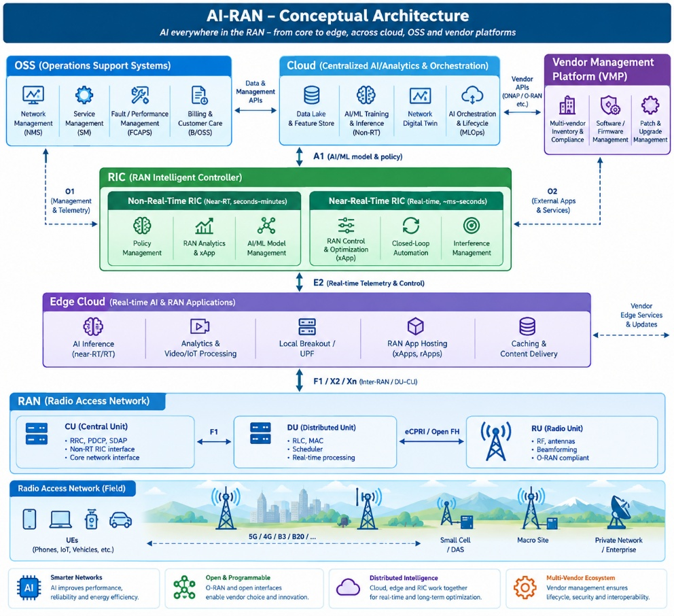
Figure 2: Conceptual AI-RAN architecture. These are logical functions, not necessarily separate systems. Training may run on a central platform while inference runs at the edge or inside a RAN control framework.
Stage 1: Collect the right data
Data category | Example measurements | Purpose |
|---|---|---|
Radio quality | RSRP, RSRQ, SINR, CQI | Assess radio conditions |
Resource utilization | DL/UL PRB utilization, active users | Identify load and capacity pressure |
Service performance | Throughput, latency, packet loss | Assess user experience |
Mobility | Handover attempts, successes, failures | Identify mobility problems |
Equipment health | Alarms, error counters, temperature | Detect abnormal operation |
Traffic patterns | Cell-level volume, hourly trends | Forecast demand |
Infrastructure | Backhaul utilization, power consumption | Identify non-radio constraints |
Sources include Performance Management (PM), Fault Management (FM), Configuration Management (CM), drive tests, UE measurement reports, transport monitoring, and site power systems. Data access varies by vendor, so operators must confirm which measurements are available, at what granularity, and how often.
Stage 2: Prepare data and train models
Raw data needs cleaning: handle missing values, align timestamps, map measurements to the correct cell and carrier, and derive useful features. A single reading of 75% PRB utilization says little; combined with its growth rate, history, active users, and neighbor load, it tells a story.
Three ML approaches are especially useful:
- Supervised learning learns from labeled history, for example predicting whether a cell will become congested.
- Unsupervised learning finds unusual patterns without labels, for example abnormal combinations of alarms and counters.
- Reinforcement learning and optimization compares alternative actions against an objective, usually in simulation or controlled environments first.
Training, validation, and inference are separate stages. Test on data the model has never seen, monitor after deployment, and retrain only through controlled model-management procedures.
Stage 3: Turn predictions into actions
Suppose a model predicts an 85% chance of congestion in an LTE cell within 30 minutes. That prediction alone changes nothing. A decision engine weighs options such as traffic steering, supported parameter adjustments, or capacity expansion, while considering neighbor load, coverage, handover stability, backhaul limits, and operator policy.
The control path depends on the architecture: existing OSS and vendor management systems, a supported Open RAN control application, or another validated mechanism. Not every RAN parameter is reachable through every interface.
Stage 4: Verify the result
After a change, the system compares throughput, PRB utilization, mobility, and drops against predefined acceptance criteria. If the target cell improves but neighbors get overloaded, the result is still a failure, so feedback must cover the whole affected area.
Safe deployments use access controls, audit logs, configuration snapshots, bounded automation, and rollback. The maturity path is:
Monitor → Predict → Recommend → Apply controlled actions → Expand automation after validation
5. AI-RAN, Open RAN, and SON: clearing up the confusion
These terms are often mixed up. Open RAN promotes disaggregated RAN functions and open interfaces. AI-RAN is about using AI in RAN operations and infrastructure. They are complementary, not the same thing, and AI can be deployed in proprietary architectures without the full Open RAN framework.
In O-RAN architectures, the RAN Intelligent Controller (RIC) hosts optimization applications:
- The Non-Real-Time RIC handles control loops longer than one second (rApps).
- The Near-Real-Time RIC targets roughly 10 milliseconds to one second (xApps).
These are architectural timescales, not guarantees that every application meets a given latency target. An xApp or rApp may use AI, but does not have to. Open interfaces improve integration flexibility but do not automatically guarantee multi-vendor interoperability, unrestricted radio control, or better performance.
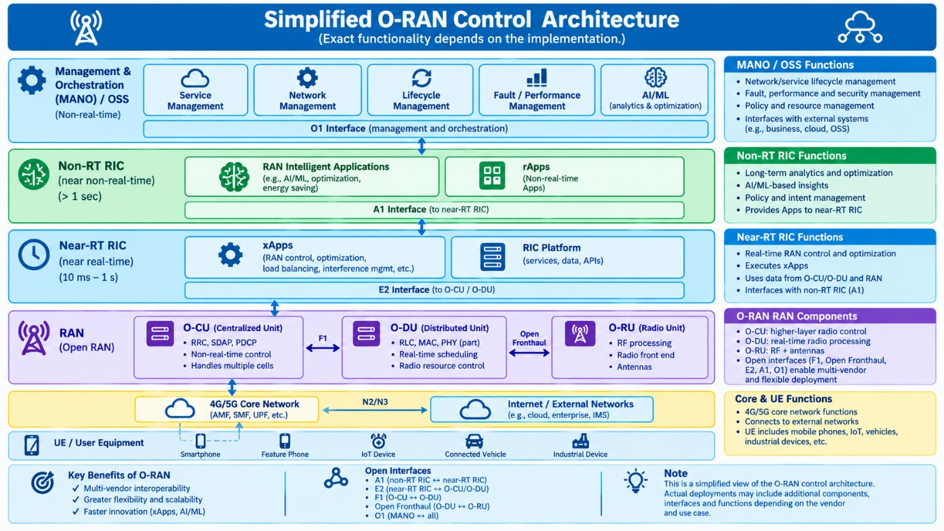
Figure 3: Simplified O-RAN control architecture; exact functionality depends on the implementation.
How is this different from traditional SON?
Self-Organizing Networks already automate configuration, optimization, and fault management, and some use ML.
Aspect | Traditional SON | AI-enhanced RAN |
|---|---|---|
Decision logic | Rules and algorithms; sometimes ML | Rules, ML, optimization, or combinations |
Traffic handling | Responds to observed conditions | Can forecast future conditions |
Fault management | Alarms and diagnostic rules | Can detect complex anomalies and correlations |
Adaptation | Depends on configured algorithms | Can adapt through validated model updates |
Safety | Operational constraints and controls | Still requires constraints, monitoring, and rollback |
AI-RAN is an evolution of network intelligence, not a claim that conventional automation is obsolete.
6. Six ways AI helps in a real network
6.1 Smarter traffic and capacity management
AI studies historical patterns, active users, PRB utilization, and neighbor conditions to forecast congestion.
In practice: A commercial district peaks after 5:00 PM. The model spots the build-up and recommends steering suitable users to neighbors with spare capacity. The operator then checks that throughput improved without overloading neighbors or hurting handovers.
6.2 Energy saving that respects coverage
Radio equipment draws power even when traffic is low. AI can forecast demand and identify when supported energy-saving modes can be used.
In practice: A rural site has a predictable nighttime lull. The system recommends a suitable carrier or cell energy-saving state, subject to coverage, capacity, and wake-up requirements. Track energy consumption, energy per gigabyte, availability, and traffic recovery.
Guardrail: Never switch off radio resources just because traffic is low. Coverage obligations, emergency services, mobility, and minimum capacity must stay protected.
6.3 Better mobility and handovers
Poorly tuned mobility parameters cause failed, excessive, or ping-pong handovers.
In practice: Cells along a highway show recurring handover failures under certain traffic conditions. The model finds the pattern and recommends an engineering review of mobility settings and coverage. Judge success by handover success rate, radio-link failures, drops, and service continuity, not merely the number of handovers.
6.4 Interference and radio optimization
Interference lowers SINR, spectral efficiency, and throughput.
In practice: An overlap area shows recurring low SINR. AI links it to specific load conditions and proposes candidate changes to supported radio parameters or coordination policies. Any change must respect radio planning, regulatory limits, and neighbor constraints. AI cannot remove interference that truly needs more spectrum, antenna redesign, or physical changes.
6.5 Predictive maintenance and fault detection
Traditional fault management reacts to alarms. AI can flag abnormal patterns before a major alarm.
In practice: A site shows slowly worsening performance, rising error counters, and repeated minor alarms. An anomaly model flags it before a bigger outage. An anomaly score is not a root cause, so engineers still verify whether the issue lies in radio equipment, power, antennas, or transport.
6.6 Network planning and digital twins
A digital twin is a digital representation of a network used to test behavior under different scenarios, combining propagation models, geospatial data, configurations, and traffic forecasts.
In practice: Before adding an LTE or 5G site, planners compare candidate locations, predicted coverage, demand, and neighbor interactions in a calibrated simulation. Reliable planning still depends on accurate terrain data, real measurements, and engineering validation.
7. Worked example: AI optimizes one LTE cell
Take a hypothetical LTE cell with high busy-hour PRB utilization and falling downlink throughput.
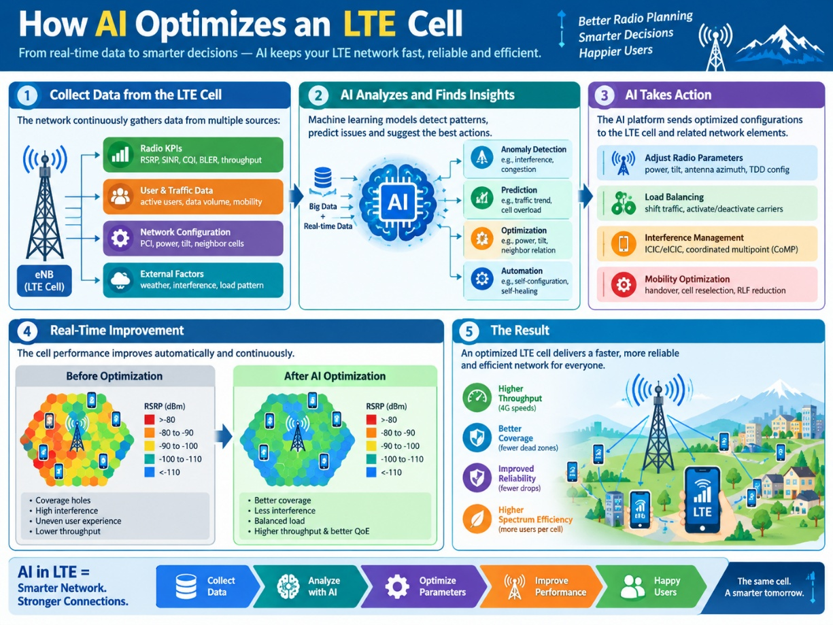
Figure 4: LTE cell optimization flow.
Step 1: Diagnose
Is it congestion, poor signal, interference, a transport limit, or a mix? A model might look at:
Input | Example value | Interpretation |
|---|---|---|
Downlink PRB utilization | 88% | High resource utilization |
Mean SINR | 12 dB | Radio quality indicator; the distribution also matters |
Neighbor-cell PRB utilization | 52% | Possible spare capacity |
Traffic growth | Rising | Potential future congestion |
Backhaul utilization | 45% | No obvious saturation in this illustrative case |
These figures are hypothetical and do not establish a diagnosis on their own.
Step 2: Choose the lever
- Neighbors have coverage and spare capacity: traffic steering may help.
- All cells are congested: more spectrum or capacity may be needed.
- Backhaul is the bottleneck: radio optimization alone will not solve it.
Step 3: Measure the outcome
KPI | Before | Illustrative post-action result |
|---|---|---|
Serving-cell PRB utilization | 88% | 72% |
Neighbor-cell PRB utilization | 52% | 65% |
Average user DL throughput | 6 Mbps | 9 Mbps |
Handover success rate | 98.5% | At least 98.5% |
These are example targets, not observed or guaranteed improvements. A real deployment must compare comparable traffic periods and account for other network changes. The goal is not simply lower PRB utilization; it is better service quality while keeping coverage, mobility stability, and neighbor performance intact.
8. Where should the AI run?
Placement of inference affects latency, data transport, computing needs, and complexity. There is no universal best location.
Location | Best for | Trade-off |
|---|---|---|
Central cloud or data center | Historical analysis, model training, network-wide forecasting, capacity planning | Lots of compute, but more transport delay and data movement |
Regional or edge platform | Regional optimization, selected real-time analytics, proximity to RAN data | Lower transport needs, but extra edge infrastructure and tighter resources |
Near the RAN control function | Control applications needing tighter response times | Demanding timing, reliability, isolation, and integration requirements |
A model forecasting next month's demand can run centrally; a time-sensitive control application may need to run much closer to the RAN.
9. Is it worth it? Benefits and how to measure them
Potential benefits:
- More consistent user experience
- More efficient use of spectrum and radio resources
- Lower energy use in suitable scenarios
- Earlier detection of developing faults
- Faster troubleshooting and lighter operational workload
- Better-informed capacity planning and investment
Results vary by network, model, implementation, and baseline. Avoid assuming AI delivers a fixed percentage gain in throughput or cost savings. A sound evaluation uses a baseline period, a controlled pilot, a comparison group where feasible, and clear acceptance criteria. Track throughput, congestion duration, handover success, drop rate, energy consumption, fault-detection time, and total cost to implement and operate.
10. What can go wrong: challenges and risks
Risk | Why it matters |
|---|---|
Data quality and availability | Missing or inconsistent measurements reduce model reliability |
Model drift | Traffic, configurations, and user behavior change, so models need monitoring and revalidation |
Real-time constraints | AI workloads must not interfere with scheduling or other critical radio operations |
Vendor integration | Vendors expose different data, management capabilities, and control interfaces |
Security and privacy | More software, data pipelines, model artifacts, and access paths need protection |
Conflicting objectives | Saving energy may cut capacity; fixing one cell may hurt another |
Automation risk | A wrong recommendation applied without validation can degrade service |
The practical lesson: introduce AI progressively. Begin with analytics and recommendations, and allow bounded automation only after the model and control process have proven reliable, with policy constraints, auditability, staged rollout, and rollback.
11. A roadmap for Nepal
Nepal's operators can improve operations on existing networks without waiting for nationwide 5G. A phased approach builds capability while limiting technical and financial risk.
1. Establish the data foundation. Collect LTE performance counters, alarms, traffic histories, configuration records, and site energy data. Verify quality, accessibility, and integration with vendor systems.
2. Pilot low-risk applications. Start with traffic forecasting, alarm correlation, anomaly detection, and predictive maintenance. Use AI to inform engineers rather than change live parameters.
3. Introduce AI-assisted optimization. Test traffic steering, mobility recommendations, and energy-saving decisions in selected cells that represent different traffic and radio conditions.
4. Validate controlled automation. Allow limited, reversible actions with engineering approval, policy constraints, audit logs, KPI guardrails, and rollback.
5. Scale on measured benefits. Expand only after verifying performance gains, lifecycle costs, operational readiness, and reliability.
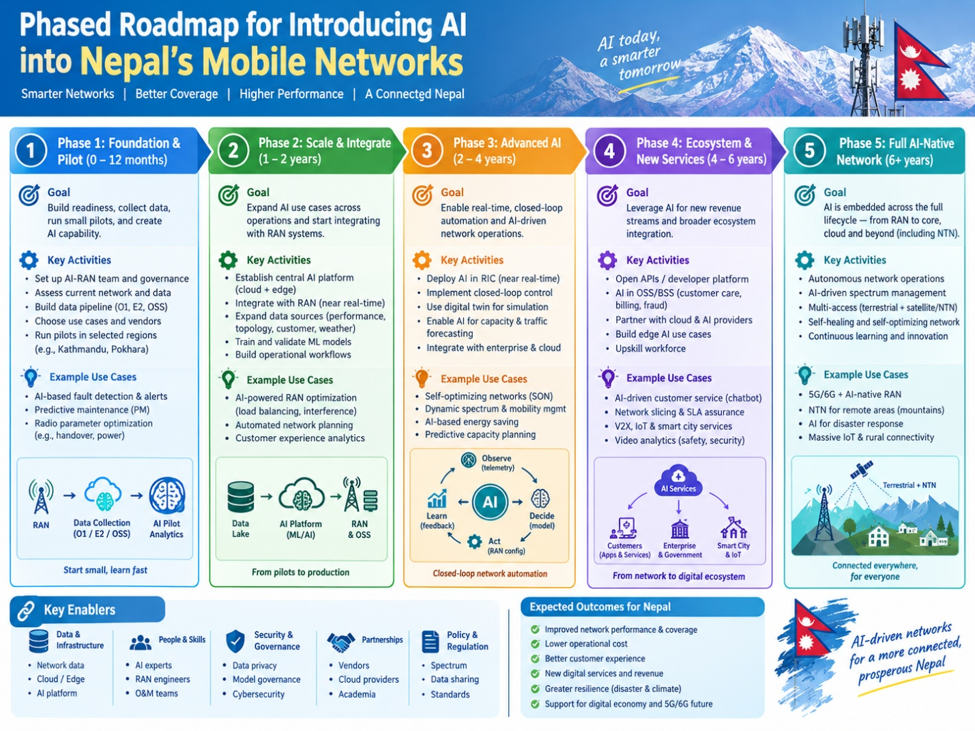
Figure 5: Suggested phased roadmap for introducing AI into Nepal's mobile networks.
Where it could help first
Region or scenario | Opportunity |
|---|---|
Kathmandu Valley | Forecast localized congestion and balance load in dense urban cells |
Terai | Identify high-demand corridors and support evidence-based capacity expansion |
Hilly and mountainous regions | Prioritize predictive maintenance where site access is difficult |
Remote, power-constrained sites | Evaluate energy savings while protecting coverage and availability |
Existing LTE infrastructure | Use historical PM counters and OSS data as the starting point for analytics |
Results will depend on available data, vendor support, transport capacity, engineering resources, and the cost of integrating AI with existing systems. For Nepal Telecom and other operators, the first business case should target clearly measurable problems rather than adopting AI because it is new.
12. Looking ahead: toward 5G Advanced and 6G
AI-assisted optimization is relevant to today's LTE and 5G networks. Longer term, AI may be integrated more deeply into network architecture, resource management, and perhaps the radio interface itself. 5G Advanced opens the door to more intelligent operations, while 6G research under the ITU's IMT-2030 framework explores AI-native networking and integrated sensing and communication.
Possible developments include:
- Distributed intelligence across devices, edge, RAN, and cloud
- More adaptive radio-resource management
- AI-assisted beam management and mobility
- Integrated sensing and communication
- Better coordination between terrestrial and non-terrestrial networks
- More automated service and network management
These are at different maturity levels. Some AI-assisted optimization can be deployed today, while other concepts remain research topics or future standardization goals. AI-native 6G should not be treated as a deployed, standardized capability. The transition will depend on demonstrated performance, standardized interfaces, computing efficiency, reliability, and commercial value, not AI capability alone.
Conclusion: smarter networks, still engineered by people
AI-RAN is an important step in how mobile networks are monitored, optimized, and operated. By combining radio measurements, machine learning, engineering constraints, and feedback, operators can move from reactive troubleshooting toward predictive and increasingly autonomous operations.
The strongest early opportunities are traffic forecasting, anomaly detection, predictive maintenance, and carefully controlled energy optimization. More advanced uses, such as automated mobility optimization and tighter integration with RAN control, need stronger validation and deeper integration.
For Nepal, the practical path starts with existing LTE infrastructure, reliable data, and well-defined operational problems, proven through measured pilots before wider investment.
The principle to remember: AI should strengthen radio engineering, not replace it. Success depends on reliable data, sound technical decisions, secure integration, and measurable improvements in user experience and network efficiency.
Disclaimer
The views and technical opinions expressed in this blog are my own and are presented from my perspective as a Communication Engineer. They are intended for technical discussion and knowledge sharing and should not be considered an official position, policy, or statement of any organization or institution with which I am affiliated.