5G from Space: Extending Connectivity Beyond the Reach of Towers (NR NTN)

Summary
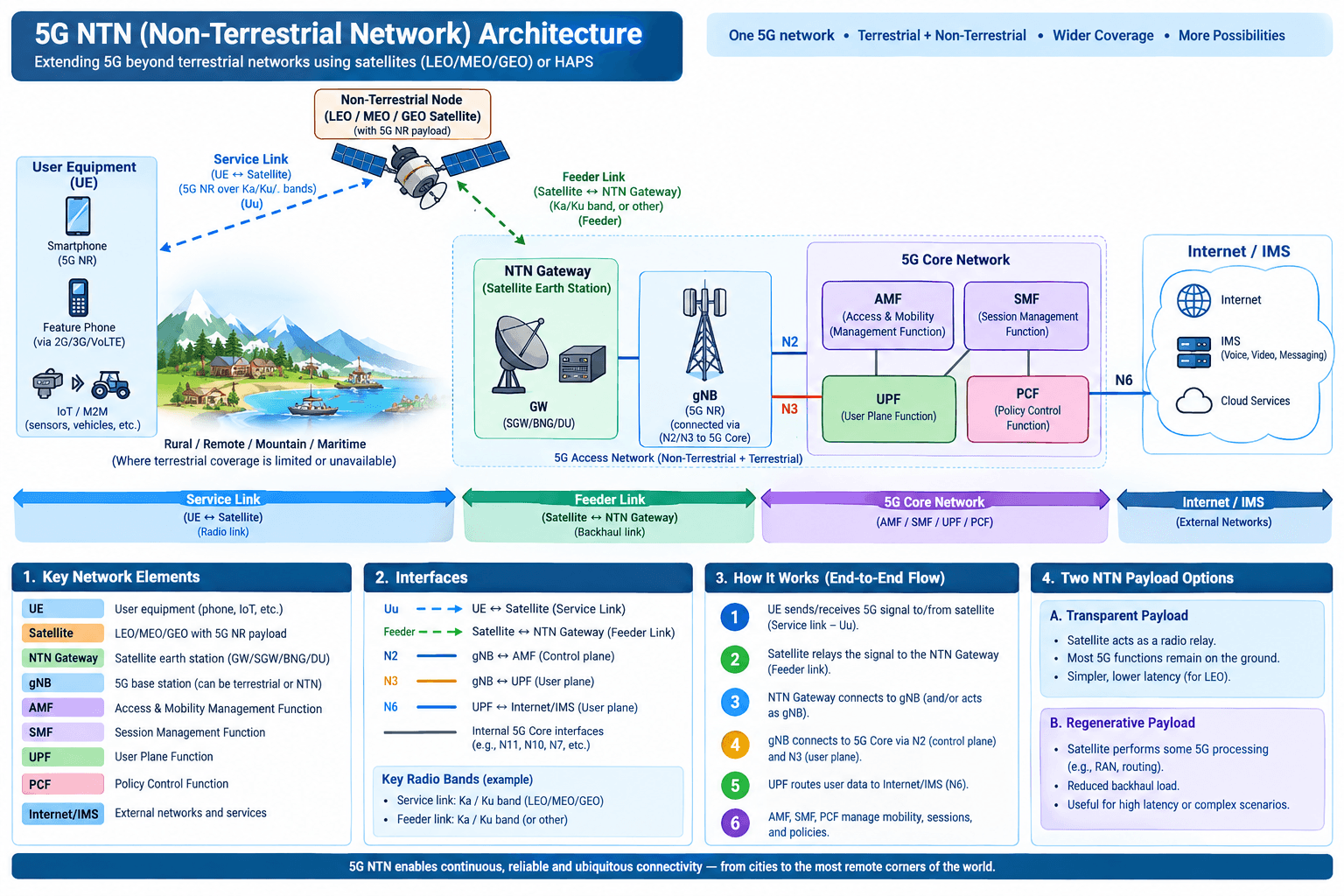
5G Non-Terrestrial Networks (NTN) are not a replacement for terrestrial 5G; they are an extension of mobile connectivity to places where conventional networks cannot reach. By combining satellite technology with cellular standards, NTN can help connect remote communities, support emergency communications and improve network resilience.
Key Takeaways
• What is 5G NTN? A mobile communication link through LEO, MEO or GEO satellites, using either a ground-based gNB (transparent payload) or an onboard gNB (regenerative payload).
• Why 5G over 4G? 5G NR provides NTN-specific timing and Doppler compensation, flexible numerology and adaptable HARQ operation. 4G also supports satellite connectivity, particularly through NB-IoT and LTE-M for IoT applications.
• Where does it stand? According to the cited GSA figures, by mid-April 2026, 21 operator–satellite partnerships had launched direct-to-cell services, while 57 operators across 35 countries had some form of commercial satellite offering.
• What are the physical limits? In the illustrative link budget, a phone uplink achieves approximately 5 dB SNR using one PRB at a 30° elevation angle. A 5 MHz satellite beam delivers around 6 Mbit/s of aggregate capacity shared among users within that beam.
• Can satellites hand over to terrestrial networks? 5G NTN-to-terrestrial mobility is supported by standardized procedures in applicable architectures. Interworking with 4G LTE depends on network and core compatibility. Many current direct-to-cell services rely on satellite coverage selection and reselection rather than seamless handover.
The Bottom Line
The future of mobile connectivity is not towers versus satellites; it is towers and satellites working together. For Nepal, NTN could complement terrestrial networks across mountainous terrain, remote settlements and disaster-affected areas, extending connectivity where building conventional infrastructure is difficult or uneconomical.
1. What NTN means and how it works
A Non-Terrestrial Network (NTN) is a 5G access network whose radio node (or the relay in front of it) sits above the ground instead of on a tower. 3GPP standardized it in Release 17 (frozen 2022), and Releases 18 and 19 widened it. The UE still speaks 5G NR; only the path between the phone and the core network changes.
The platforms differ mainly by altitude, and altitude sets delay, coverage footprint and how fast the satellite moves relative to the user.
Platform | Altitude | One-way delay to UE (approx.) | Footprint per beam / cell | Motion seen from ground |
LEO | 300 to 1,500 km | 2 to 8 ms (RTT 25 to 60 ms incl. feeder) | 50 to 500 km | Fast: 7 km/s, pass of 5 to 10 min |
MEO | 7,000 to 25,000 km | 30 to 60 ms | 100s to 1,000 km | Medium, hours of visibility |
GEO | 35,786 km | about 120 ms (RTT about 540 ms) | 200 to 1,000 km spot | Fixed, no Doppler to speak of |
HAPS | 8 to 50 km | under 1 ms | 5 to 200 km | Quasi-static |
UAS / drone | under 8 km | under 1 ms | 1 to 20 km | Controlled |
The delay and Doppler figures follow from orbital geometry, not from any vendor choice, so they hold for any operator.
Two payload architectures
The 3GPP NTN specification defines two ways to build the satellite, and the choice drives almost every later design decision.
• Transparent (bent-pipe) payload. The satellite only shifts frequency, filters and amplifies. The gNB sits on the ground, next to the NTN gateway. Rel-17 NR-NTN is built around this model. It is simple and cheap, but every packet crosses the feeder link twice and the gNB must handle huge delay.
• Regenerative payload. The satellite carries a full or partial gNB (gNB-DU or complete gNB). It decodes, processes and can route signals, including inter-satellite links. Rel-19 adds this. It saves feeder spectrum and allows onboard switching, at the cost of a heavier, more power-hungry satellite.
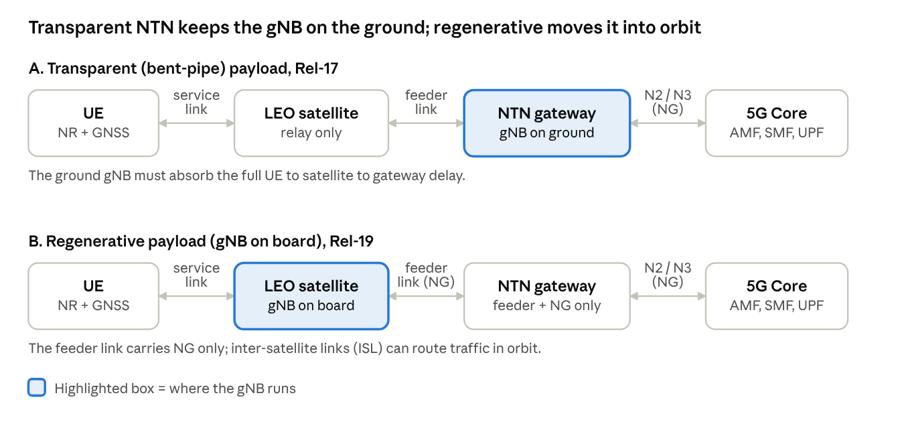
Figure: NTN architecture, transparent vs regenerative payload.
In A the satellite is a mirror; in B it is a base station with a backhaul. Everything else in this blog (timing, Doppler, handover) follows from which of the two you buy.
End-to-End Process of 5G NTN
1. Satellite Broadcast: The satellite broadcasts SSB and system information. SIB19 provides satellite ephemeris, common timing-advance parameters, and validity information.
2. UE Synchronization: Using GNSS positioning and satellite data, the UE estimates propagation delay and Doppler shift and pre-compensates its uplink transmission.
3. Random Access: The UE sends a PRACH preamble through the satellite. The gNB responds with the remaining timing-advance correction to synchronize uplink transmission.
4. 5G Core Connection: RRC and NAS signaling establishes the connection and registration through the NTN access network to the 5G Core, including AMF, SMF, and UPF.
5. User Data Transmission: Data travels between the UE, satellite, NTN gateway, gNB, and UPF before reaching the Internet or other networks. Traffic may use local breakout or centralized routing.
6. Mobility and Handover: As LEO satellites move, the network manages earth-fixed or earth-moving beams and coordinates beam or satellite handovers to maintain service continuity.
Key message: 5G NTN extends 5G connectivity through satellites by compensating for propagation delay and Doppler shift, integrating with the 5G Core, and managing satellite mobility for continuous communication.
2. Why NTN Is Mainly Associated with 5G Rather Than 4G
4G LTE was originally designed for communication between ground-based mobile towers and phones. It was not designed to handle the long delays and high speeds of satellites. In contrast, 5G NR was developed with more flexible technical features, making satellite communication easier to support. The main differences are explained below.
2.1 Timing and propagation delay
In 4G, a mobile phone must transmit data at the correct time so that it reaches the base station in synchronization with other users. LTE's timing advance and feedback mechanisms were designed mainly for terrestrial networks. Satellite communication introduces significantly greater propagation delay than terrestrial cellular communication. The delay depends on satellite altitude, orbital geometry and the communication path.
• 4G LTE: Conventional LTE timing advance (TA), uplink scheduling and HARQ feedback procedures were primarily designed for terrestrial cells. LTE's basic timing-advance command has a range of approximately 0.67 ms of timing adjustment, corresponding to a maximum nominal cell radius of roughly 50 km under idealized assumptions. The original LTE procedures do not directly accommodate the very long propagation delays of satellite links.
• 5G NR NTN: 3GPP introduces NTN-specific timing procedures, including timing compensation based on GNSS position and satellite ephemeris (position information), as well as the scheduling offset K_offset. These mechanisms compensate for satellite propagation delay and help align uplink transmissions with the network's reception timing. It introduces additional timing support, UE-side timing compensation and scheduling offsets. HARQ feedback can also be disabled when appropriate. These features help 5G handle the long delays associated with satellite communication.
For a GEO satellite, the satellite-to-ground distance can approach 36,000 km in one direction. A representative ground-to-satellite-to-ground path therefore introduces a propagation delay of approximately 240–280 ms one way and around 500–560 ms round trip, depending on geometry.
Consequently, conventional terrestrial scheduling and feedback timers cannot simply be applied unchanged to GEO links. NTN-specific timing procedures are required to maintain reliable radio communication.
2.2 HARQ and data retransmission
Hybrid Automatic Repeat reQuest (HARQ) combines error detection, feedback and retransmission to improve link reliability. Its efficiency depends on the time required to receive feedback and retransmit data.
• 4G LTE: Its conventional HARQ operation is designed for relatively short terrestrial delays. Long satellite delays can reduce efficiency because the network must wait longer for feedback.
• 5G NR NTN: It supports adjustments to HARQ operation, including disabling HARQ feedback where appropriate. This reduces the impact of long delays, although it does not eliminate the delay itself.
Note: LTE has eight HARQ processes in conventional configurations, while NR supports up to 16 or 32 processes depending on the configuration. The number of processes alone does not determine NTN capability. NTN performance depends on the combined effects of HARQ configuration, scheduling, transport-block processing, retransmission policy and the satellite link's propagation delay, not merely the number of HARQ processes.
2.3 Doppler shift and subcarrier spacing
Satellite movement produces Doppler frequency shift, which affects carrier-frequency synchronization and orthogonal frequency-division multiplexing (OFDM).
The Doppler shift can be approximated by:
f_D ≈ (v_r / c) × f_c
• f_D = Doppler frequency shift
• v_r = relative radial velocity between the satellite and UE
• c = speed of light
• f_c = carrier frequency
For example, a LEO satellite operating at a carrier frequency of 2 GHz may produce a Doppler shift of several tens of kilohertz, depending on the orbital velocity and observation geometry.
Satellites, especially Low Earth Orbit (LEO) satellites, move rapidly relative to users on the ground. This movement causes a Doppler shift, changing the apparent frequency of the received signal.
• 4G LTE: It uses a fixed 15 kHz subcarrier spacing for conventional LTE operation, making large and rapidly changing Doppler shifts more challenging to manage.
• 5G NR NTN: It supports multiple subcarrier spacings, including 15, 30, 60 and 120 kHz, and provides mechanisms for Doppler pre-compensation.
A larger subcarrier spacing can improve tolerance to certain frequency errors relative to the subcarrier spacing, but it is not a complete solution to Doppler. Accurate compensation of the predicted Doppler shift and its time variation remain important, particularly for LEO satellites.
NR numerology flexibility, combined with NTN-specific synchronization procedures, helps maintain OFDM performance in satellite environments.
2.4 Core network support
The core network must support authentication, session management, mobility, policy enforcement and routing for users connected through satellite access.
• 4G EPC: The Evolved Packet Core (EPC) can support satellite-connected LTE access when the radio access and network architecture are designed accordingly. However, the original LTE/EPC specifications did not include all the NTN-specific procedures subsequently standardized for satellite connectivity. It was primarily designed for terrestrial mobile networks and does not support satellite mobility and long propagation delays.
• 5G Core: The service-based architecture supports flexible integration of different access technologies. 3GPP Release 17 introduced important NR NTN enhancements and associated core-network support for satellite access, with further improvements in later releases. Standardized NTN-related enhancements help manage satellite access, mobility and service continuity.
The network may need to account for extended communication delays, satellite access characteristics, mobility and regulatory requirements. Nevertheless, these capabilities should not be interpreted as exclusive to the 5G Core: LTE-based satellite access also has standardized support, particularly for IoT services.
2.5 Radio access architecture and mobility management
NTN introduces mobility characteristics that differ from terrestrial cellular networks. A satellite beam may cover a very large geographical area, and a LEO satellite or its beams may move relative to the Earth's surface.
• 4G LTE: The conventional terrestrial RAN and EPC mobility procedures were designed mainly around fixed base-station locations and terrestrial cell coverage. Satellite deployment may require adaptations to support extended delays, moving coverage areas and satellite-specific access procedures.
• 5G NR NTN: 3GPP has introduced NTN-specific procedures for satellite access, timing, mobility and system information. Depending on the architecture, the network must account for satellite ephemeris, service-link geometry, beam movement and changes in the serving satellite or cell.
Two deployment concepts are particularly important:
• Earth-fixed beams: The satellite beam maintains approximately the same geographical coverage area as the satellite moves, subject to the satellite system's design.
• Earth-moving beams: The coverage area moves across the Earth's surface with the satellite, potentially requiring more frequent mobility and tracking-area management.
These differences affect cell selection, handover, paging and service continuity. NTN does not automatically require every satellite beam to be treated as a moving cell; the mobility design depends on the satellite and beam architecture.
2.6 Spectrum, devices and commercial development
The development of 5G NTN has also benefited from advances in mobile chipsets, satellite-compatible frequency bands and standardization.
• 4G LTE: Satellite integration was not a primary design objective of the original LTE standards.
• 5G NTN: 3GPP has defined satellite-related operating bands, including n255, n256 and n254, for applicable NTN deployments. Compatible modem chipsets can support satellite connectivity alongside terrestrial cellular services, subject to the device's supported bands, radio capabilities and network implementation.
The availability of compatible devices, satellite infrastructure and standardized network interfaces helps make 5G NTN an increasingly important platform for integrated terrestrial and satellite connectivity. This creates opportunities for a more integrated connectivity solution using terrestrial mobile networks and satellites.
Takeaway:
The technical advantage of 5G NR NTN is not simply that 5G uses a newer radio interface. Its significance lies in the combination of NTN-specific timing compensation, flexible numerology, Doppler management, HARQ adaptation, satellite-aware mobility procedures and standardised integration with the 5G Core.
These capabilities make NR NTN a strong foundation for integrating terrestrial mobile networks with satellite networks, including broadband connectivity through LEO and GEO satellites.
However, NTN is not exclusive to 5G. 3GPP has also standardized satellite connectivity for LTE-based technologies, particularly NB-IoT and LTE-M. The more accurate distinction is that 5G NR NTN provides a broader framework for satellite-enabled mobile broadband, while 4G NTN support is available for specific technologies and deployment scenarios.
What 4G Supports: IoT over Satellite
3GPP Release 17 standardized satellite support for NB-IoT and LTE-M, which are low-power, low-data-rate technologies designed for IoT devices. These technologies can be adapted for satellite links to handle applications such as sensor monitoring, asset tracking and emergency SOS messages.
For example, companies such as Skylo and Sateliot provide satellite-based IoT connectivity. However, these services are mainly designed for small data transmissions rather than smartphone voice calls or high-speed broadband.
In short: 4G-based NTN mainly supports IoT applications, while 5G NR NTN provides a broader framework for future satellite-based mobile broadband.
3. 5G NTN around the world
By mid-April 2026, GSA counted 57 operators in 35 countries and territories with commercial satellite offerings of some kind, and satellite-to-cellphone services launched in 17 countries (GSA, NTN Connectivity May 2026). 21 operator and satellite partnerships had launched direct-to-cell service, 29 were trialing it and 73 were planning it. Starlink leads on partnerships, and the first Western European service started in February 2026.
"5G NTN" is used loosely in the press. Three different things are being sold under the label:
1. Direct-to-cell on existing phones. The satellite acts as a base station in the operator's own terrestrial spectrum (for example PCS 1900 MHz), and unmodified LTE phones connect. This is NTN in function and is being aligned with 3GPP, but it is not the same as a Rel-17 NR-NTN phone.
2. Standards-based NB-IoT and 5G NTN for devices. Sensors, trackers and SOS messengers use Rel-17 or Rel-19 NTN modes.
3. Community and enterprise broadband. VSAT-style backhaul or terminals through a partnership, which GSA reports as 38% of all operator and satellite partnerships.
GSA also notes that only a limited number of devices support the 3GPP narrowband NTN standards, so the large consumer numbers today come mostly from the first type.
Two market shifts matter for operators. First, satellite vendors are buying their own mobile-satellite (MSS) spectrum instead of borrowing operator spectrum.
4. Uplink and downlink in 5G NTN, step by step
The uplink is the key limiting factor in satellite communication with handheld devices. A typical smartphone transmits at around 23 dBm (0.2 W) through an antenna with approximately 0 dBi gain, whereas a satellite or terrestrial base station can use high-power transmitters and large antenna arrays to achieve much greater effective radiated power. This section explains the uplink radio chain and quantifies the link budget to show how these power differences affect communication performance.
4.1 Spectrum
Rel-17 defines FDD-only NTN bands in two frequency ranges.
Range | Bands | Typical use |
FR1 (below 7.125 GHz), mobile satellite spectrum | n255 (L-band), n256 (S-band, 1980 to 2010 MHz uplink and 2170 to 2200 MHz downlink), n254 (Big LEO, 1610 to 1626.5 MHz uplink and 2483.5 to 2500 MHz downlink) | Handheld phones, IoT |
FR2-NTN (Ka-band) | n510, n511, n512 (roughly 27.5 to 30 GHz uplink, 17.3 to 20.2 GHz downlink) | VSAT-style terminals, vehicles, ships, aircraft |
Operator IMT bands (not a 3GPP NTN band) | Terrestrial 700 to 2600 MHz bands used by direct-to-cell vendors | Existing LTE or NR phones, with operator permission |
Feeder links between the satellite and gateway run in a higher band (typically Ka, Q or V band), independent of the user band.
4.2 Downlink Chain in 5G NTN
1. Signal generation: The gNB generates standard 5G NR signals, including PDSCH (data), PDCCH (control) and SSB (synchronization).
2. Feeder link and beamforming: The gateway sends signals to the satellite, which directs them towards users through spot beams, each serving an NR cell.
3. Doppler compensation: The network compensates for satellite-induced Doppler shift to reduce the residual frequency error at the UE.
4. Broadcast information: SSB and system information are transmitted. SIB19 provides satellite ephemeris, common timing advance, its drift and validity, and the scheduling offset K_offset.
5. UE synchronization: The UE detects SSB, reads SIB19 and uses GNSS positioning to calculate uplink timing and frequency pre-compensation.
6. Feedback: Long propagation delays affect CQI reporting and HARQ feedback. HARQ feedback can be disabled in supported configurations.
4.3 Uplink Chain in 5G NTN
1. Timing and frequency pre-compensation: The UE uses its GNSS position and satellite ephemeris to estimate propagation delay and Doppler shift, then adjusts its transmission timing and frequency.
2. Random access: The UE sends a PRACH signal to establish access. The network accommodates the remaining timing uncertainty and uses appropriate random-access response and contention-resolution timers.
3. Timing advance calculation: The final uplink timing accounts for UE-specific propagation delay, common satellite-related delay and network corrections obtained during random access.
4. Scheduling with offset: The K_offset mechanism provides additional time between scheduling information and the corresponding uplink transmission. Related protocol timers and feedback timing are configured to accommodate the satellite delay.
5. Uplink transmission in low-rate waveform: The UE transmits data using a supported uplink waveform, modulation and resource allocation. Low-order modulation, narrow bandwidth and repetitions may be used when needed to improve coverage or reduce power consumption.
6. Re-sync: The UE updates its satellite-related system information and timing estimates as required. If the required positioning or timing information becomes unavailable or invalid, it must follow the applicable NTN procedures to maintain safe and valid transmission timing.
Key difference: In terrestrial 5G, the network primarily adjusts uplink timing using timing-advance commands. In NTN, the UE also applies satellite-specific timing and frequency pre-compensation to account for the much longer propagation delay and satellite movement.
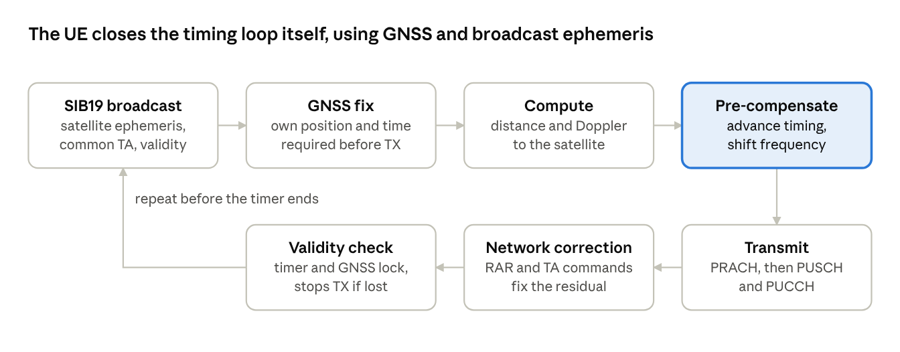
Figure: UE timing and frequency pre-compensation loop (7 steps).
The network never needs the satellite to tell each UE its delay. The UE works it out, and the network only corrects what is left.
4.4 Doppler, delay and cell dwell
A LEO satellite at 600 km moves at about 7.56 km/s, so a UE at 2 GHz sees the Doppler swing from about +45 kHz to about −45 kHz during an 8.5 minute pass (10 degree minimum elevation). Near zenith the shift changes by roughly 500 Hz per second, which is why a UE cannot rely on tracking alone and must pre-compensate.
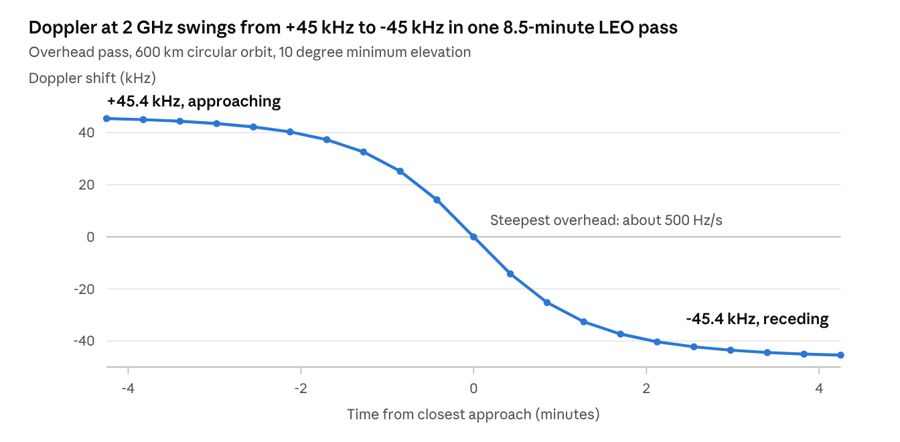
Figure: Doppler frequency shift during a single LEO satellite pass at a 2 GHz carrier.
This chart shows how the Doppler frequency shift changes during a single pass of a Low Earth Orbit (LEO) satellite operating at a carrier frequency of 2 GHz..
• X-axis: Time relative to the satellite's closest approach to the user, from approximately 4 minutes before to 4 minutes after.
• Y-axis: Doppler frequency shift in kHz.
• Satellite approaching: Doppler is positive, reaching approximately +45.4 kHz.
• Closest approach (0 minutes): Doppler crosses approximately 0 kHz.
• Satellite moving away: Doppler becomes negative, reaching approximately −45.4 kHz.
The example assumes a 600 km circular orbit and a minimum elevation angle of 10°. The satellite remains visible for approximately 8.5 minutes.
Doppler shift
Doppler shift depends on the satellite's radial velocity, the component of its velocity towards or away from the UE.
• Before closest approach: positive Doppler.
The satellite approaches the UE, so the received frequency is higher than the transmitted carrier frequency.
• At closest approach: approximately zero Doppler.
The satellite's radial velocity is approximately zero at the point of closest approach, although its overall orbital speed remains high.
• After closest approach: negative Doppler.
The satellite moves away from the UE, so the received frequency is lower than the transmitted carrier frequency.
The sign depends on the chosen convention; this chart uses positive for approaching and negative for receding.
Importance in 5G NTN
At a 2 GHz carrier frequency, a Doppler shift of 45.4 kHz is significant compared with the 15 kHz subcarrier spacing commonly used in 5G NR.
If left uncompensated, this frequency offset can cause inter-carrier interference (ICI), degrade channel estimation and affect synchronization.
5G NTN therefore uses mechanisms such as:
• Doppler pre-compensation: The network and/or UE estimates the expected frequency shift using satellite orbital information and positioning.
• Frequency synchronization: The receiver corrects the remaining frequency error.
• Continuous tracking: Compensation is updated as the satellite's relative position and velocity change.
The chart's steepest slope is approximately 500 Hz/s near overhead. This indicates that the Doppler shift can change rapidly even when its instantaneous value is close to zero.
Key takeaway:
A LEO satellite's Doppler shift changes from positive to negative during a pass. 5G NTN must compensate for both the frequency offset and its rate of change to maintain reliable communication.
4.5 Link budget: why the uplink limits you
A link budget calculates whether a radio signal has enough power to travel from the transmitter to the receiver with acceptable quality.
In 5G NTN, the uplink (UE → satellite) is often the limiting link because smartphones have limited transmit power, while satellites are far away and experience significant free-space path loss.
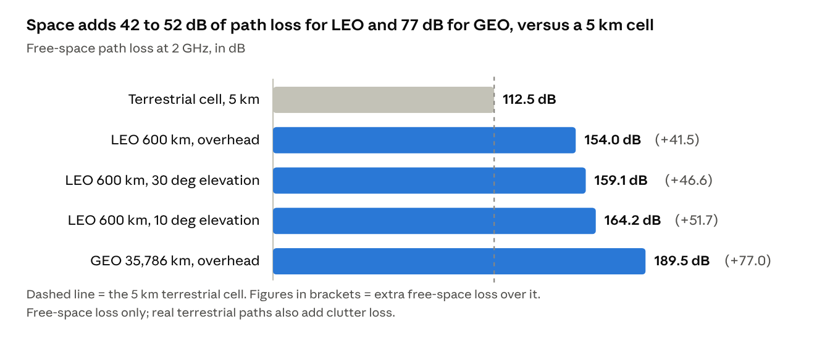
Figure (calculated, free-space loss formula, 2 GHz)
This gap is why satellites need large arrays and why the phone side is limited to very low rates.
The example below is my own calculation from round numbers in the style of the S-band, LEO 600 km reference set in 3GPP TR 38.821. Treat it as illustrative, not as a vendor guarantee.
Item | Downlink | Uplink |
Frequency | 2 GHz (n256) | 2 GHz (n256) |
Satellite altitude, elevation, slant range | 600 km, 30 degrees, 1,075 km | same |
Free-space path loss | 159.1 dB | 159.1 dB |
Other losses (0.1 atmosphere, 3 polarisation, 3 shadow) | 6.1 dB | 6.1 dB |
Transmit power | Satellite EIRP density 34 dBW/MHz | UE EIRP 23 dBm (-7 dBW), 0 dBi antenna |
Receiver | UE, 0 dBi, 7 dB noise figure | Satellite G/T 1.1 dB/K |
Bandwidth | 1 MHz reference (SNR is the same at any bandwidth for a fixed density) | 180 kHz (1 PRB at 15 kHz spacing) |
Resulting SNR | about 5.8 dB | about 5.0 dB |
The uplink only closes with one PRB. Every doubling of the allocation costs 3 dB of SNR, so a phone cannot burst at tens of Mbit/s from space; it sends text, voice, and modest data, and it needs a clear view of the sky.
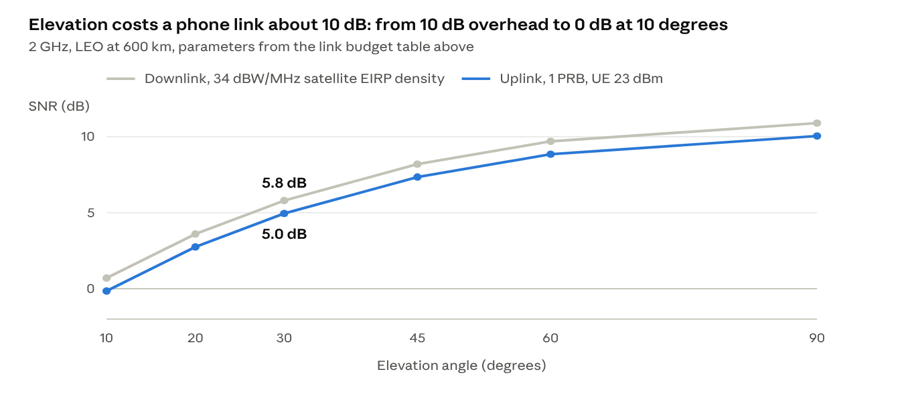
Figure (calculated, link budget table above): SNR at 6 elevation angles.
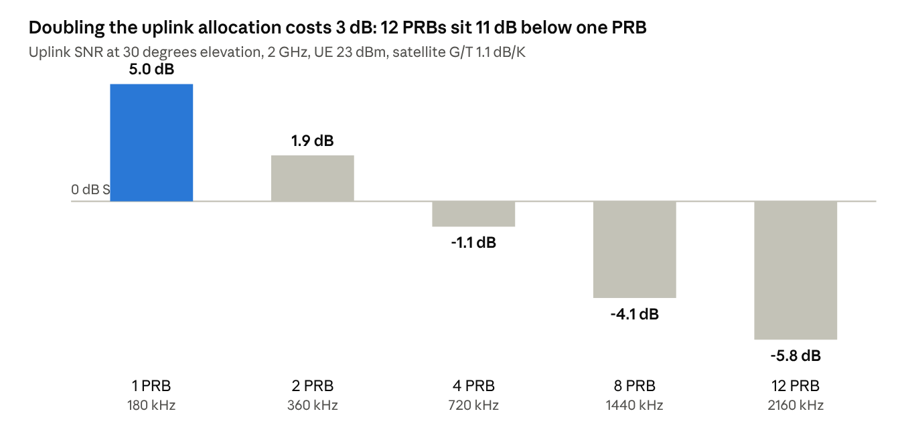
Figure (calculated, uplink at 30 degrees): SNR for 1 to 12 PRBs.
Low elevation costs both links about 10 dB. On the uplink, a narrow allocation is the only lever the phone has.
5. Where NTN is viable and feasible
NTN is viable where demand is thin, spread out, or suddenly cut off, and not viable as a substitute for a terrestrial network. Three physical limits decide this: capacity per beam is small and shared, the phone uplink is weak, and indoor and in-vehicle signal loss is large on top of the free-space loss shown earlier.
The capacity limit is easy to see. If a 5 MHz downlink carrier runs at about 1.2 bit/s per Hz (roughly QPSK at the SNR in the earlier budget), one beam carries about 6 Mbit/s. A beam of 50 km diameter covers about 1,960 km², and everyone in it shares that rate.
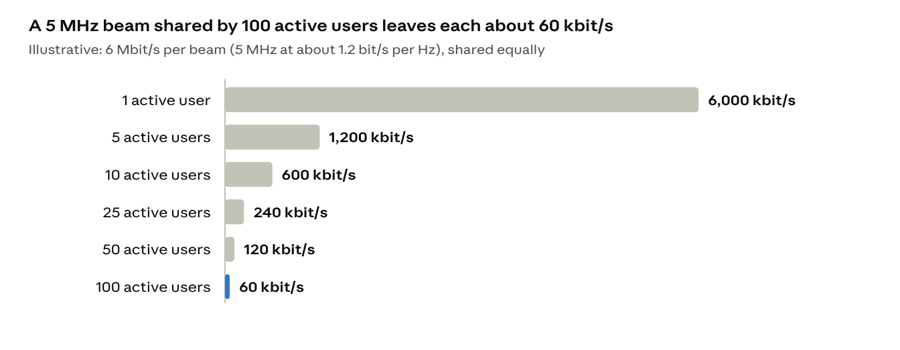
Figure (illustrative): 6 Mbit/s per beam, shared equally.
This is why NTN is a coverage tool and not a capacity tool: the beam is big, and the pipe in it is small.
A simple test for an operator is to ask three questions in order:
1. Can a tower, microwave hop or fiber reach it at acceptable cost? If yes, build terrestrial.
2. If not, is the traffic text, voice, sensors or fixed-site broadband? If yes, NTN is a fit.
3. If the demand is indoor or dense, stay terrestrial and use NTN only as a backup.
6. Handover between NTN and terrestrial 4G or 5G
A 5G NTN cell is an ordinary NR cell in the 5G Core, so a UE can move between it and a terrestrial 5G cell with the same procedures as any NR mobility. Moving to terrestrial 4G is also possible, but only through inter-RAT interworking between the 5G Core and the 4G core. In live services today, most phones fall back by cell reselection when the terrestrial signal is lost, not by a seamless mid-call handover.
The NTN to 5G terrestrial link is the easy one. The 4G link is the one that needs a deliberate core design.
What the standard added for NTN (Rel-17 onward) is the part that makes mobility predictable despite moving cells:
• Time and location triggers. Conditional handover can fire on a timer (when the serving satellite will stop covering the area, signaled as t-Service) or on UE distance from a reference point, not only on signal strength.
• Ephemeris in the neighbor list. SIB19 can carry the ephemeris of neighbouring satellite cells, so the UE can pre-compute timing and Doppler before it connects.
• Earth-fixed tracking areas. Even when cells move, tracking areas stay fixed on the ground, so the core paging area does not change every few seconds.
• Feeder-link switch. When a satellite hands its gateway to a new one, the network updates the common timing parameters, and the UE follows through system information.
The operator-side prerequisites are what decide whether a design can hand over at all.
• One PLMN or equivalent PLMNs. If the satellite network is a separate PLMN, the phone treats it as roaming and will not hand over seamlessly.
• Shared core. A single 5GC (or an EPC with interworking) must anchor the session so the IP address survives the move. Voice needs IMS reachable from both sides.
• Prefer-terrestrial policy. Cell priorities, thresholds and timers must favour the terrestrial layer, because satellite capacity is scarce and its uplink is weak.
• UE capability. The phone needs the NTN band, GNSS, and the NTN procedures. A phone without them will never select the satellite cell.
7. Conclusion and Suggestion
5G NTN is currently best suited for emergency messaging, basic voice fallback, IoT connectivity, and fixed-site services, rather than replacing terrestrial networks for everyday mobile broadband. Operators should deploy it as a coverage extension and resilience layer, with clear handover and fallback rules that return devices to terrestrial networks whenever available. This approach delivers connectivity where it is most needed while avoiding unrealistic capacity expectations and unnecessary investment.
Sources
• GSA, NTN Connectivity May 2026
• Light Reading, NTT Docomo direct-to-cell plan
• SatNews, AT&T and AST SpaceMobile after BlueBird 6
• Satellite Today, Verizon and AST SpaceMobile agreement
• NextMSC, 5G NTN market from trials to IoT launches (Myriota)
• Iridium, NTN Direct
• Wikipedia, OQ Technology
• Communications Today, Nepal moves closer to a 5G auction
Elucidations :
Doppler Effecet Management:
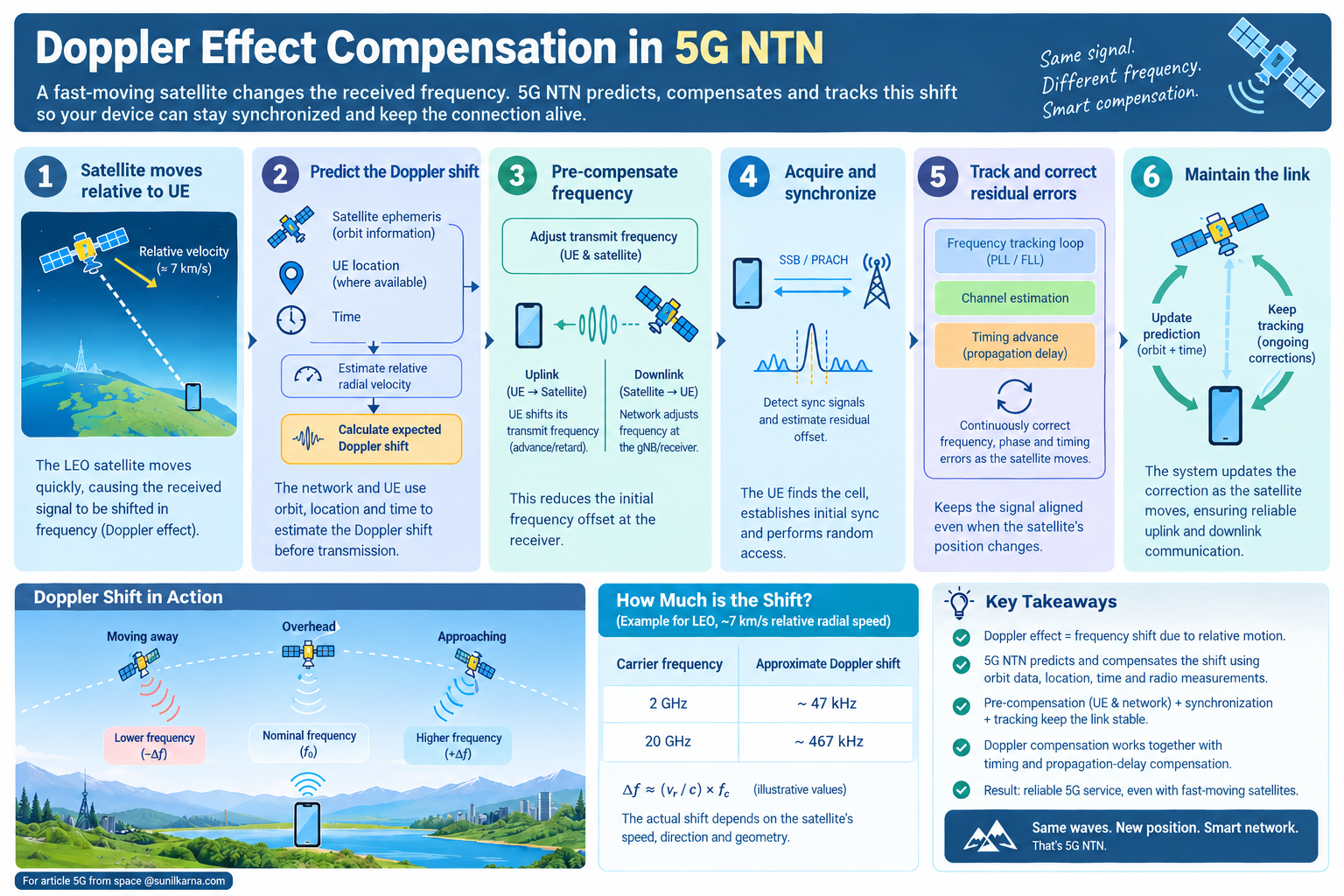
The infographic above illustrates the complete 5G NTN Doppler compensation process, from satellite movement and Doppler prediction to frequency pre-compensation, synchronization, residual-error correction and continuous link maintenance.
Flowchat Diagram of Doppler Effect Management:
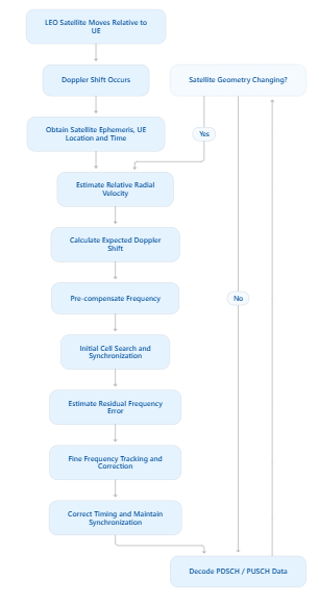
Takeaway : 5G NTN predicts the frequency shift, corrects as much as possible in advance and continuously tracks the remaining error to keep the satellite connection reliable.
Delay Management:
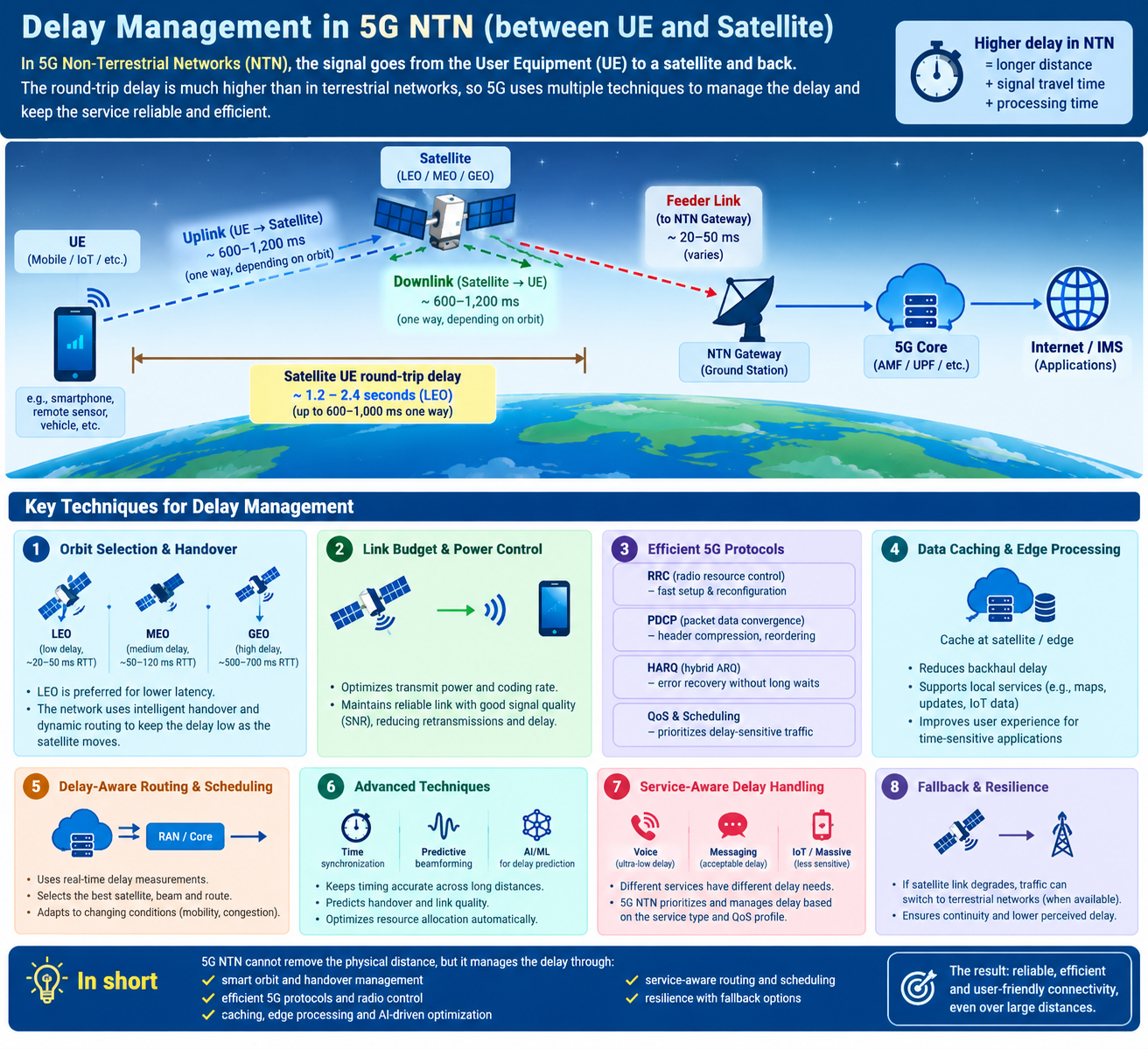
The infographic above illustrates the signal path, sources of delay, and the main techniques used to manage it. In 5G NTN, delay occurs mainly because radio signals travel a long distance between the User Equipment (UE) and the satellite. The network cannot eliminate this physical propagation delay, but it can reduce additional waiting time and manage communication efficiently.
Takeaway : 5G NTN delay management combines orbit selection, radio engineering, protocol adaptation, and intelligent scheduling. LEO reduces the physical delay, while NTN-aware network design helps prevent additional delays and maintain reliable connectivity.
Disclaimer
The views and technical opinions expressed in this blog are my own and are presented from my perspective as a Communication Engineer. They are intended for technical discussion and knowledge sharing and should not be considered an official position, policy or statement of any organization or institution with which I am affiliated.